
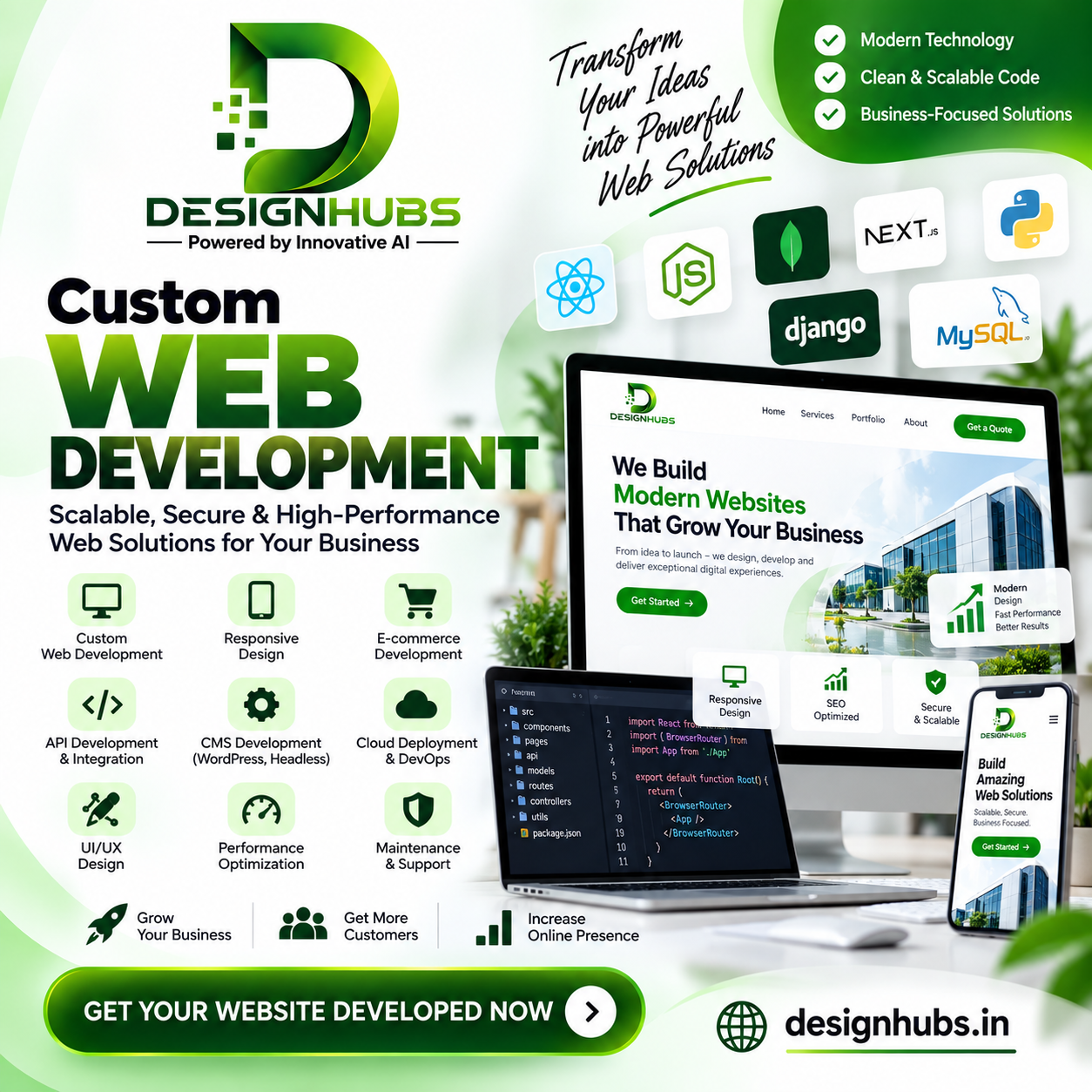
Website Development: A Complete Guide to Professional Web Development Services
A professional website has become an essential digital asset for businesses of almost every size and industry. Whether you are starting a new business, expanding an existing company, launching an e-commerce store, building an online platform, or improving an outdated website, professional website development can help create a reliable digital foundation for your business.
Website development is not only about creating web pages. It involves planning the website structure, developing functionality, connecting databases and APIs, optimizing performance, implementing security, ensuring mobile responsiveness, and creating a platform that can support the business's requirements.
For businesses looking for a website development company, choosing the right technology, development approach, features, and support model is important.
At DesignHubs, we provide website design, website development, software solutions, e-commerce solutions, graphic designing, and digital marketing services for businesses looking to build and improve their digital presence.
What Is Website Development?
Website development is the process of creating and maintaining a website or web application.
It includes the technical implementation behind a website, such as:
-
Frontend development
-
Backend development
-
Database integration
-
API integration
-
Website functionality
-
Content management systems
-
Authentication
-
Payment integration
-
Third-party integrations
-
Security
-
Performance optimization
-
Hosting and deployment
Website development can range from a simple business website to a complex web application with multiple users, databases, dashboards, APIs, and business workflows.
Website Design vs Website Development
Website design and website development are related but different areas.
Website design focuses primarily on the visual appearance and user experience of the website.
It includes:
-
Layout
-
Colors
-
Typography
-
Images
-
User interface
-
Navigation
-
User experience
Website development focuses on converting the planned design into a functional website.
It may involve:
-
HTML
-
CSS
-
JavaScript
-
PHP
-
Python
-
Databases
-
APIs
-
Frameworks
-
CMS platforms
-
Server-side programming
A successful website project generally requires both effective design and reliable development.
Why Professional Website Development Matters
A website represents your business online. It may be used by customers to learn about your company, explore products, submit enquiries, make purchases, book services, or communicate with your team.
Professional website development can help businesses create websites that are:
-
Functional
-
Responsive
-
Scalable
-
Secure
-
Search-friendly
-
Fast
-
Easy to maintain
The development approach should be based on the purpose of the website and the requirements of the business.
Types of Website Development Services
Different businesses require different types of websites.
Some common website development services include:
-
Business website development
-
Corporate website development
-
Custom website development
-
E-commerce development
-
CMS website development
-
Web application development
-
Portal development
-
Landing page development
-
Real estate website development
-
Education website development
-
Healthcare website development
-
Membership website development
The technology and architecture can vary depending on the complexity of the project.
Frontend Website Development
Frontend development refers to the part of a website that users interact with directly.
Common frontend technologies include:
-
HTML
-
CSS
-
JavaScript
-
React
-
Other frontend frameworks and libraries
Frontend development focuses on creating interactive and responsive interfaces.
A professional frontend should work across different screen sizes and browsers while maintaining a consistent user experience.
Important Frontend Elements
Frontend development can include:
-
Navigation menus
-
Forms
-
Buttons
-
Sliders
-
Cards
-
Product sections
-
Search interfaces
-
Filters
-
Dashboards
-
Animations
-
Interactive components
The choice of technology depends on the project requirements.
Backend Website Development
Backend development handles the server-side functionality of a website or web application.
It can include:
-
Business logic
-
User authentication
-
Database operations
-
API communication
-
Form processing
-
Data management
-
Payment processing
-
Admin functionality
Backend technologies can include languages and frameworks such as PHP, Python, Node.js, and others depending on project requirements.
Database Integration
Many websites and web applications need to store and retrieve information.
Examples include:
-
Customer information
-
Product information
-
Orders
-
Leads
-
User accounts
-
Blog content
-
Bookings
-
Transactions
Databases such as MySQL and other database technologies can be used depending on the application's requirements.
A properly structured database helps applications manage information efficiently.
Custom Website Development
Not every business can use the same website structure.
A business may require custom functionality such as:
-
Customer dashboards
-
Employee portals
-
Booking systems
-
CRM integration
-
API integrations
-
Custom forms
-
Product management
-
User registration
-
Payment systems
-
Reporting dashboards
In such cases, custom website development can provide more flexibility than a basic template-based website.
A custom website can be developed around the company's specific workflow and requirements.
CMS Website Development
A Content Management System, or CMS, allows businesses to manage website content without changing the underlying code for every update.
CMS platforms can be useful for websites that frequently publish:
-
Blogs
-
News
-
Products
-
Services
-
Images
-
Company updates
A CMS can provide administrative functionality for managing website content.
The right CMS depends on the project's technical requirements, budget, content structure, and future plans.
E-Commerce Website Development
E-commerce development involves building websites that allow businesses to sell products or services online.
An e-commerce website may include:
-
Product catalog
-
Product categories
-
Search
-
Filters
-
Product details
-
Shopping cart
-
Wishlist
-
Checkout
-
Payment gateway
-
Customer accounts
-
Order management
-
Shipping integration
-
Coupons
-
Inventory management
The development process should consider both the customer shopping experience and the administrative requirements of the business.
Payment Gateway Integration
Online businesses may require payment gateway integration to accept digital payments.
Depending on the country, business model, and payment provider, websites can integrate different payment solutions.
Payment integration may support:
-
Credit cards
-
Debit cards
-
Net banking
-
UPI
-
Digital wallets
-
Other supported payment methods
Payment systems should be implemented carefully with appropriate security and error-handling practices.
API Integration in Website Development
APIs allow different software systems to communicate with each other.
A website may require API integrations for:
-
Payment gateways
-
CRM systems
-
Maps
-
Shipping platforms
-
SMS services
-
Email platforms
-
Social media
-
Business applications
-
Third-party software
For example, a website enquiry form can potentially send customer information to a CRM through an API.
API integration can help connect a website with the rest of a business's technology ecosystem.
CRM Integration with Websites
Businesses that generate leads through their websites can integrate the website with a CRM.
A typical workflow may look like:
Website Enquiry → CRM → Lead Assignment → Follow-Up → Sales Process
This can help businesses organize customer enquiries and track their sales activities.
CRM integration can be particularly useful for:
-
Real estate companies
-
Education businesses
-
B2B companies
-
Service providers
-
Financial businesses
-
Agencies
-
Sales-driven organizations
The exact integration depends on the CRM and website technology.
Responsive Website Development
A modern website should work across multiple devices.
Responsive website development allows the website layout to adapt to:
-
Smartphones
-
Tablets
-
Laptops
-
Desktop computers
Responsive development can involve flexible layouts, responsive images, appropriate typography, mobile navigation, and touch-friendly interface elements.
Mobile responsiveness is important because users may access the same website from different devices.
Website Performance Optimization
Website speed is an important part of user experience.
A slow website may make it difficult for visitors to browse pages or complete actions.
Website performance can be improved through techniques such as:
-
Image optimization
-
Code optimization
-
Browser caching
-
Lazy loading
-
Efficient database queries
-
File compression
-
Reduced unnecessary scripts
-
Optimized hosting
-
Content delivery networks
Performance optimization should be considered during development.
SEO-Friendly Website Development
Website development and SEO are closely connected.
A technically well-developed website can provide a stronger foundation for search engine optimization.
SEO-friendly development may include:
-
Clean URL structure
-
Proper heading hierarchy
-
Mobile responsiveness
-
Fast loading
-
Crawlable pages
-
XML sitemap
-
Internal linking
-
Optimized images
-
HTTPS
-
Structured data where appropriate
Technical implementation alone does not guarantee search rankings, but it can support broader SEO efforts.
Secure Website Development
Security should be considered throughout the development lifecycle.
Depending on the website, security measures may include:
-
HTTPS
-
Secure authentication
-
Password protection
-
Input validation
-
Access control
-
Secure API handling
-
Database security
-
Software updates
-
Regular backups
Websites handling customer accounts, payments, or sensitive business information may require additional security considerations.
Website Development for Different Industries
Website requirements vary from one industry to another.
Real Estate Website Development
A real estate website may require:
-
Property listings
-
Property search
-
Filters
-
Location information
-
Property galleries
-
Enquiry forms
-
Agent profiles
-
Site-visit requests
-
CRM integration
Education Website Development
Educational websites may include:
-
Courses
-
Programs
-
Admissions
-
Faculty
-
Events
-
Online registration
-
Student enquiries
-
Learning resources
Healthcare Website Development
Healthcare websites may include:
-
Services
-
Doctors
-
Departments
-
Appointment requests
-
Patient information
-
Contact forms
-
Location details
The implementation should be planned according to the organization's requirements and applicable privacy/security considerations.
Corporate Website Development
Corporate websites often include:
-
Company profile
-
Services
-
Industries
-
Leadership
-
Portfolio
-
Case studies
-
Careers
-
Contact information
Corporate websites generally require structured information architecture and consistent branding.
Software Company Website Development
Software and technology companies may require websites featuring:
-
Technology services
-
Software products
-
Case studies
-
Solutions
-
Industries
-
Documentation
-
Demo forms
-
Contact forms
The website can also be integrated with lead management systems and analytics tools.
Website Development for Startups
Startups often need to launch their digital presence quickly while keeping the platform scalable.
A startup website may start with:
-
Homepage
-
About
-
Services or product
-
Features
-
Pricing
-
Contact
-
Blog
As the business grows, additional functionality can be introduced.
A scalable development approach can make future improvements easier.
Website Development for Small Businesses
Small businesses may need websites that are simple, professional, and focused on generating enquiries.
Features may include:
-
Service pages
-
Contact forms
-
WhatsApp integration
-
Phone integration
-
Google Maps
-
Testimonials
-
Portfolio
-
FAQs
-
Blog
A small business website does not necessarily need complex technology. The technology should match the actual requirements.
Web Application Development
A web application is more interactive than a standard informational website.
Examples include:
-
CRM systems
-
Project management systems
-
Booking platforms
-
Customer portals
-
Employee management systems
-
Learning platforms
-
Business dashboards
Web applications may require:
-
User authentication
-
Databases
-
Role-based access
-
APIs
-
Dashboards
-
Notifications
-
Reporting
-
Advanced business logic
Custom web application development requires careful planning of the application's architecture and workflow.
Portal Development
Web portals provide access to information or functionality for different types of users.
Examples include:
-
Customer portals
-
Employee portals
-
Vendor portals
-
Education portals
-
Business portals
Different users may receive different permissions and functionality.
For example, an administrator may manage the entire system while customers can access only their own information.
Website Admin Panel
Many websites require an administrative dashboard.
An admin panel can allow authorized users to manage:
-
Website content
-
Products
-
Orders
-
Users
-
Leads
-
Blog posts
-
Enquiries
-
Images
-
Reports
A well-designed admin panel can reduce the need for developers to make routine content updates.
Website Development Process
A structured website development process helps organize the project.
Step 1: Requirement Analysis
The first stage involves understanding the business and technical requirements.
Questions may include:
-
What is the purpose of the website?
-
Who is the target audience?
-
What pages are required?
-
What features are needed?
-
Is a CMS required?
-
Is CRM integration required?
-
Is payment functionality required?
-
What are the SEO requirements?
Step 2: Planning
The website structure, sitemap, features, technology, integrations, and development approach are planned.
Step 3: UI/UX Design
The visual interface and user journey are designed based on the project requirements.
Step 4: Frontend Development
The approved design is converted into responsive frontend components.
Step 5: Backend Development
Server-side functionality, business logic, databases, APIs, and administrative features are developed.
Step 6: Integration
Required third-party systems, APIs, payment gateways, CRM systems, or other services are integrated.
Step 7: Content Integration
Text, images, videos, products, and other website content are added.
Step 8: Testing
The website is tested for:
-
Functionality
-
Responsiveness
-
Forms
-
Links
-
Browser compatibility
-
Performance
-
Security
-
User flows
Step 9: SEO Setup
Basic technical SEO elements can be implemented according to the project requirements.
Step 10: Deployment
The website is deployed to the production hosting environment.
Step 11: Maintenance
After launch, businesses may require:
-
Updates
-
Security maintenance
-
Content changes
-
Bug fixes
-
Performance optimization
-
Feature additions
How Much Does Website Development Cost?
There is no single price for website development because every project has different requirements.
Website development cost can depend on:
-
Number of pages
-
Design complexity
-
Custom functionality
-
Technology
-
CMS
-
E-commerce features
-
Payment gateway
-
CRM integration
-
API integrations
-
Database requirements
-
User accounts
-
Admin panel
-
Content requirements
-
SEO requirements
-
Hosting
-
Maintenance
A simple business website can have significantly different requirements from a custom web application.
For this reason, businesses should discuss their requirements with a website development company before finalizing the project scope and budget.
How to Choose a Website Development Company
Choosing the right development partner is an important decision.
Businesses can evaluate development companies based on:
Portfolio
Review previous websites and web applications.
Technical Expertise
Understand the technologies and platforms the company works with.
Custom Development Capability
If you require custom functionality, confirm whether the company can develop features specifically for your business.
Responsive Development
Make sure websites are developed for mobile, tablet, and desktop devices.
SEO Knowledge
A development company with SEO awareness can build a stronger technical foundation for future optimization.
Security
Ask about security practices, backups, authentication, and maintenance.
Support
Understand what support is available after launch.
Communication
Clear project communication helps keep development aligned with business requirements.
Why Choose DesignHubs for Website Development?
DesignHubs provides professional website design and development services for businesses looking to establish, improve, or expand their online presence.
Our services include:
-
Website Design
-
Website Development
-
Custom Website Development
-
E-commerce Development
-
Software Solutions
-
Digital Marketing
-
SEO
-
Graphic Designing
We can work on projects ranging from business websites and corporate websites to e-commerce platforms and customized web solutions.
The development approach can be planned according to the business's requirements, target audience, functionality, technology, and future growth plans.
Website Development and Digital Marketing
Website development and digital marketing work closely together.
A business may invest in SEO, Google Ads, social media marketing, or other campaigns to bring visitors to its website.
Once visitors arrive, the website needs to:
-
Load properly
-
Explain the business clearly
-
Work on mobile devices
-
Provide relevant information
-
Make contact easy
-
Support conversions
This is why website development should be considered as part of the overall digital strategy.
Website Development and SEO
SEO is not something that should always be added after a website is completed.
Development decisions can influence:
-
Page speed
-
Mobile experience
-
URL structure
-
Navigation
-
Indexing
-
Content hierarchy
-
Internal linking
-
Technical accessibility
Building an SEO-friendly technical foundation from the beginning can make future optimization more manageable.
Website Maintenance
A website requires ongoing attention after launch.
Maintenance can include:
-
Software updates
-
Security updates
-
Backups
-
Content updates
-
Plugin updates
-
Performance checks
-
Bug fixes
-
Technical improvements
Businesses should consider maintenance requirements when planning their website project.
When Should You Build a New Website?
A new website may be appropriate when:
-
You are launching a new business.
-
Your current website is outdated.
-
The website is not mobile-friendly.
-
The current technology is difficult to maintain.
-
Your business has changed significantly.
-
You need new functionality.
-
The current website does not support SEO requirements.
-
You need e-commerce functionality.
-
You need CRM integration.
-
You want to improve the customer experience.
The decision should be based on the current website's limitations and the business's future requirements.
When Should You Redesign or Rebuild a Website?
Sometimes an existing website can be improved rather than completely replaced.
However, a rebuild may be considered when the existing website has:
-
Outdated technology
-
Poor performance
-
Security issues
-
Limited scalability
-
Difficult maintenance
-
Poor mobile compatibility
-
Complex technical limitations
A technical audit can help identify which approach is appropriate.
Frequently Asked Questions About Website Development
What is website development?
Website development is the technical process of creating and maintaining websites and web applications. It can include frontend development, backend development, databases, APIs, integrations, security, and deployment.
What is a website development company?
A website development company provides professional services for planning, designing, developing, testing, deploying, and maintaining websites and web applications.
What is custom website development?
Custom website development involves creating website functionality according to a business's specific requirements rather than relying entirely on a standard template.
Is website development different from web design?
Yes. Web design primarily focuses on visual appearance and user experience, while web development focuses on the technical implementation and functionality.
Can a website be integrated with a CRM?
Yes. Depending on the CRM and technical requirements, websites can be connected to CRM systems using APIs or other integration methods.
Can DesignHubs develop e-commerce websites?
Yes. DesignHubs provides e-commerce and website development solutions that can be planned according to product, payment, order, and business requirements.
Can you develop a mobile-responsive website?
Yes. Responsive development allows websites to adapt to different devices, including smartphones, tablets, laptops, and desktops.
How long does website development take?
The timeline depends on the website's size, design, functionality, integrations, content, testing requirements, and approval process. A simple business website generally requires less development work than a complex web application.
How much does website development cost?
Website development cost depends on project requirements such as design, number of pages, functionality, integrations, CMS, e-commerce features, databases, APIs, and ongoing support.
Can an existing website be redesigned?
Yes. Existing websites can be redesigned or rebuilt depending on their technical condition, business requirements, and future goals.
Conclusion
A professionally developed website provides businesses with a digital platform for presenting their services, communicating with customers, generating enquiries, selling products, and supporting digital marketing activities.
Modern website development involves much more than creating web pages. It can include frontend development, backend development, databases, APIs, responsive design, SEO-friendly architecture, security, performance optimization, integrations, and ongoing maintenance.
Whether you need a simple business website, corporate website, e-commerce store, custom website, web application, or integrated business platform, the right development approach should be based on your specific requirements.
For businesses searching for a website development company in Delhi, DesignHubs provides website development, custom web solutions, e-commerce development, website design, software solutions, digital marketing, SEO, and graphic designing services.
If you are planning to build a new website or upgrade an existing website, you can discuss your requirements with the DesignHubs team.
DesignHubs
Phone: +91 9718 899 082
Email: info@designhubs.in