
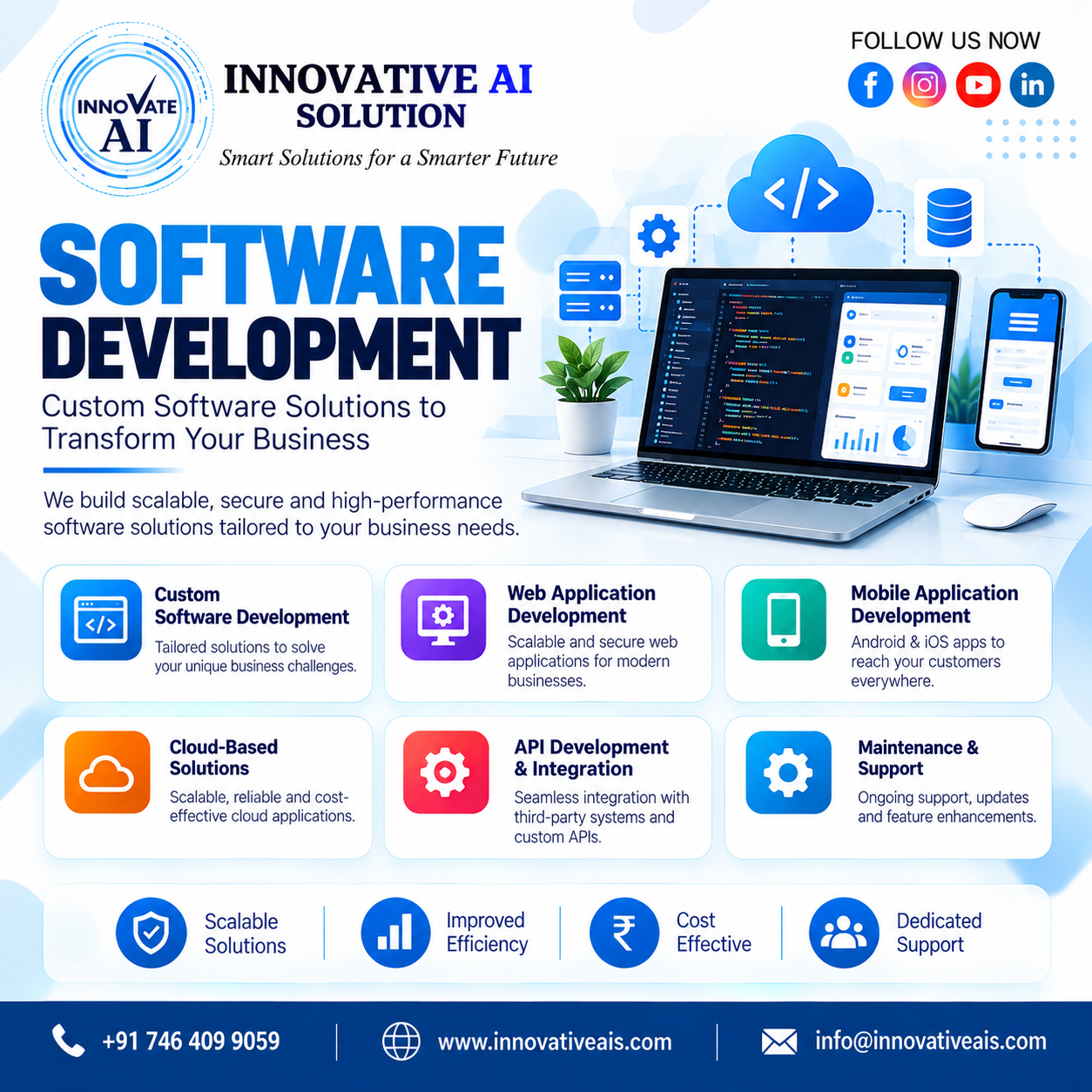
Software Development Services: Custom Software Solutions for Modern Businesses
In today’s digital business environment, software has become an essential part of almost every organization. Businesses use software to manage operations, communicate with customers, automate repetitive tasks, manage employees, process data, improve sales, and deliver better services.
Whether you are a startup, small business, growing organization, or enterprise, the right software solution can help improve productivity, reduce manual work, and create better opportunities for business growth.
Software development involves designing, developing, testing, deploying, and maintaining software applications according to specific business requirements. Unlike generic software products, custom software can be created around the exact workflow, objectives, and challenges of an organization.
A professional software development company can help businesses transform ideas and manual processes into scalable digital solutions. From web-based business applications and CRM systems to mobile applications, AI-powered software, enterprise platforms, and cloud-based solutions, software development can support businesses across different industries.
At Innovative AI Solutions, we provide technology-focused solutions designed to help businesses improve their digital operations through custom software, AI, automation, web development, mobile applications, cloud solutions, and other digital technologies.
What Is Software Development?
Software development is the process of creating software applications that solve specific problems or perform specific business functions.
The development process can include several stages:
-
Requirement analysis
-
Business process understanding
-
Software planning
-
UI/UX design
-
Architecture planning
-
Development
-
API integration
-
Database development
-
Testing
-
Deployment
-
Maintenance
-
Security updates
-
Continuous improvement
Software can be developed for different platforms, including websites, mobile devices, desktops, cloud environments, and enterprise systems.
The objective is to create software that is reliable, scalable, secure, easy to use, and aligned with business requirements.
Why Do Businesses Need Custom Software Development?
Many businesses start with spreadsheets, manual processes, emails, messaging applications, and generic software tools. These methods may work initially, but they can become difficult to manage as the organization grows.
Businesses often face challenges such as:
-
Repetitive manual work
-
Duplicate data
-
Poor communication between departments
-
Limited reporting
-
Difficult customer management
-
Data scattered across different systems
-
Slow business processes
-
Lack of automation
-
Limited integration options
-
Difficulty scaling operations
Custom software development provides an opportunity to create a system specifically designed to solve these problems.
Instead of adjusting your business workflow to fit generic software, a custom solution can be developed around your existing business process.
Custom Software Development Services
Custom software development focuses on building applications according to the specific requirements of an organization.
A custom software development project can include:
-
Business management software
-
CRM software
-
ERP solutions
-
Inventory management systems
-
Hospital management software
-
School management software
-
E-commerce platforms
-
Customer support systems
-
HR management software
-
Accounting solutions
-
Project management software
-
AI-powered applications
-
Automation platforms
-
Booking systems
-
Enterprise applications
The software can be customized based on the organization's users, workflows, departments, business rules, integrations, and reporting requirements.
Benefits of Custom Software Development
1. Designed for Your Business
Custom software is created around your business requirements.
You can define the features, workflows, dashboards, user roles, reports, and integrations required by your organization.
2. Improved Productivity
Software can automate repetitive activities and reduce the amount of manual work employees need to perform.
3. Better Business Management
A centralized software system can provide management with better visibility into business operations.
4. Scalability
Custom software can be designed to support future business growth.
As the number of users, customers, transactions, or operations increases, additional features and infrastructure can be added.
5. Integration
Custom applications can be integrated with websites, mobile apps, APIs, payment gateways, CRMs, communication platforms, cloud services, and other business systems.
6. Better Data Management
Instead of maintaining information across multiple spreadsheets and applications, businesses can manage important data through a centralized platform.
7. Automation
Businesses can automate workflows, notifications, reports, approvals, communication, and repetitive tasks.
8. Competitive Advantage
A software solution designed specifically for your business can provide capabilities that generic products may not offer.
Types of Software Development Services
A professional software development company can provide different types of development services based on business requirements.
Web Application Development
Web applications are software systems that can be accessed through web browsers.
Examples include:
-
CRM systems
-
Business dashboards
-
Customer portals
-
Employee portals
-
Booking systems
-
Management platforms
-
E-commerce systems
-
Online marketplaces
-
Educational platforms
Web applications can be accessed from computers, laptops, tablets, and smartphones depending on the design and requirements.
Mobile App Development
Mobile applications allow businesses to connect with customers and employees through smartphones and tablets.
Mobile apps can be developed for:
-
Android
-
iOS
-
Cross-platform environments
Business applications can include:
-
Customer apps
-
Delivery apps
-
Booking apps
-
E-commerce apps
-
Healthcare apps
-
Education apps
-
Finance applications
-
Employee applications
-
Field-service applications
A mobile application can also communicate with backend software through APIs.
Enterprise Software Development
Large organizations often require software capable of supporting multiple departments, users, locations, and business processes.
Enterprise software can include:
-
Enterprise resource planning systems
-
Customer relationship management platforms
-
Supply chain management systems
-
Business intelligence platforms
-
Human resource management systems
-
Workflow automation systems
-
Financial management software
Enterprise software is generally designed with scalability, security, integration, performance, and access control in mind.
SaaS Software Development
Software as a Service, commonly known as SaaS, allows users to access software through the internet, usually through a subscription model.
Examples of SaaS applications include:
-
CRM platforms
-
Project management tools
-
Marketing platforms
-
HR software
-
Accounting applications
-
Communication platforms
-
AI tools
SaaS software development requires careful consideration of multi-user architecture, subscription management, security, scalability, authentication, billing, and cloud infrastructure.
AI Software Development
Artificial Intelligence is becoming an important part of modern software development.
AI can be integrated into software applications to improve automation, data analysis, customer communication, decision-making, and productivity.
AI-powered software can include:
-
AI chatbots
-
AI calling agents
-
Recommendation systems
-
Intelligent search
-
Document processing
-
AI assistants
-
Predictive analytics
-
Automated content generation
-
Customer support automation
-
AI-based data analysis
Businesses can combine traditional software with AI technologies to create intelligent digital solutions.
AI Chatbot Development
AI chatbots can help businesses communicate with customers automatically.
A chatbot can answer frequently asked questions, collect customer information, provide product information, schedule appointments, and transfer complex conversations to human representatives.
AI chatbot solutions can be integrated into:
-
Websites
-
Mobile applications
-
Customer portals
-
CRM systems
-
Business platforms
When connected with a CRM, chatbot conversations can also help create and update customer records.
Business Process Automation
Many businesses spend significant time performing repetitive tasks.
Software automation can reduce manual work by creating predefined workflows.
For example:
New Lead → Lead Assignment → Sales Notification → Follow-Up → Proposal → Customer Conversion
Instead of employees manually performing every step, software can automate appropriate parts of the workflow.
Automation can be used for:
-
Lead management
-
Email notifications
-
Customer onboarding
-
Employee approvals
-
Invoice generation
-
Report generation
-
Follow-up reminders
-
Data synchronization
-
Task assignment
CRM Software Development
Customer Relationship Management software helps businesses manage customers, leads, sales activities, communication, and follow-ups.
A custom CRM can include:
-
Lead management
-
Customer management
-
Sales pipeline
-
Follow-up reminders
-
Employee management
-
Task management
-
Reports
-
Dashboards
-
Email integration
-
WhatsApp integration
-
AI chatbot
-
Calling integration
-
Automation
A CRM can be developed specifically for industries such as real estate, education, healthcare, finance, travel, e-commerce, and B2B services.
ERP Software Development
Enterprise Resource Planning software helps businesses manage multiple operational functions through a centralized platform.
Depending on business requirements, an ERP system can include:
-
Inventory
-
Finance
-
Sales
-
Purchase
-
Human resources
-
Payroll
-
Production
-
Customer management
-
Vendor management
-
Reporting
ERP development requires detailed understanding of business processes and strong system architecture.
E-Commerce Software Development
E-commerce software allows businesses to sell products and services online.
A custom e-commerce solution can include:
-
Product management
-
Category management
-
Customer accounts
-
Shopping cart
-
Wishlist
-
Online payments
-
Order management
-
Inventory management
-
Delivery management
-
Discount management
-
Customer notifications
-
Reports
Businesses can choose custom e-commerce development when they require features beyond standard platforms.
Industry-Specific Software Solutions
Different industries have different operational requirements.
Custom software development can create solutions specifically for individual industries.
Healthcare Software
Healthcare software can help manage:
-
Patient records
-
Appointments
-
Doctors
-
Billing
-
Pharmacy
-
Reports
-
Patient communication
Education Software
Educational institutions can use software for:
-
Student management
-
Admission management
-
Attendance
-
Fees
-
Courses
-
Faculty management
-
Parent communication
-
Online learning
Real Estate Software
Real estate companies can manage:
-
Property listings
-
Leads
-
Customers
-
Site visits
-
Agents
-
Follow-ups
-
Sales
-
Property inventory
Logistics Software
Logistics businesses can use software for:
-
Order management
-
Delivery tracking
-
Fleet management
-
Driver management
-
Customer management
-
Route management
-
Reports
Manufacturing Software
Manufacturing companies can manage:
-
Production
-
Inventory
-
Raw materials
-
Purchase orders
-
Vendors
-
Quality control
-
Employees
-
Reporting
Cloud-Based Software Development
Cloud technology allows businesses to run applications and store data through cloud infrastructure.
Cloud-based software can provide:
-
Remote access
-
Scalability
-
Centralized data
-
Flexible infrastructure
-
Automated backups
-
High availability
-
Easier deployment
Cloud applications are especially useful for organizations with remote teams or multiple business locations.
A software development company can help businesses plan, develop, deploy, and maintain cloud-based applications according to their requirements.
API Development and Integration
APIs allow different software systems to communicate with each other.
For example, an e-commerce application can communicate with:
-
Payment gateways
-
Shipping services
-
CRM platforms
-
Accounting software
-
SMS gateways
-
Email services
-
Analytics platforms
API development and integration can help businesses create connected digital ecosystems instead of isolated applications.
Software Modernization
Businesses may already have old software systems that are difficult to maintain or integrate with modern technologies.
Software modernization can help upgrade legacy applications.
Modernization may include:
-
UI redesign
-
Database migration
-
Cloud migration
-
API development
-
Architecture improvement
-
Performance optimization
-
Security improvements
-
Mobile integration
-
AI integration
Modernizing existing software can help organizations extend the life of important business applications.
Software Maintenance and Support
Software development does not end after deployment.
Applications require ongoing maintenance to remain secure, stable, and compatible with changing technologies.
Software maintenance services may include:
-
Bug fixing
-
Performance optimization
-
Security updates
-
Server management
-
Database maintenance
-
Feature enhancements
-
API updates
-
Backup management
-
Technical support
Regular maintenance can help businesses reduce downtime and maintain reliable software performance.
Software Development Process
A structured development process helps ensure that software meets business requirements.
Step 1: Requirement Gathering
The first step is understanding the business, target users, existing challenges, and expected software functionality.
The development team identifies:
-
Business objectives
-
Required features
-
User types
-
Workflows
-
Integrations
-
Reports
-
Security requirements
-
Technical requirements
Step 2: Planning
After requirements are finalized, the team creates a development roadmap.
This may include:
-
Technology selection
-
System architecture
-
Database planning
-
Feature planning
-
Development milestones
-
Testing strategy
Step 3: UI/UX Design
The interface is designed according to user requirements.
Good UI/UX should make software easy to understand and use.
Step 4: Development
Developers build the application according to the approved design and technical architecture.
The frontend, backend, database, APIs, and required integrations are developed during this stage.
Step 5: Testing
The software is tested to identify bugs and performance issues.
Testing can include:
-
Functional testing
-
UI testing
-
API testing
-
Security testing
-
Performance testing
-
Compatibility testing
-
User acceptance testing
Step 6: Deployment
Once the application has passed testing, it can be deployed to the required server or cloud environment.
Step 7: Maintenance
After deployment, ongoing support and maintenance can be provided to keep the application updated and secure.
Technologies Used in Software Development
The technology stack depends on the project requirements.
Software development can involve technologies such as:
-
HTML
-
CSS
-
JavaScript
-
React
-
Node.js
-
PHP
-
Laravel
-
Python
-
Django
-
MySQL
-
PostgreSQL
-
MongoDB
-
REST APIs
-
Cloud platforms
-
AI technologies
The right technology should be selected according to factors such as scalability, performance, security, development requirements, and future maintenance.
Secure Software Development
Security should be considered throughout the software development lifecycle.
A secure software solution may include:
-
User authentication
-
Role-based permissions
-
Secure APIs
-
Data encryption
-
Input validation
-
Secure database practices
-
Access controls
-
Backup strategies
-
Monitoring
-
Security testing
Businesses should work with experienced software developers to ensure that security requirements are properly considered.
Scalable Software Development
A software application should be capable of supporting business growth.
For example, a startup may initially have 10 employees and 1,000 customers. As the business grows, the system may need to support hundreds of employees and significantly larger amounts of data.
Scalable software architecture can help accommodate this growth.
Scalability should be considered during:
-
Database design
-
Backend development
-
API architecture
-
Cloud infrastructure
-
Application architecture
-
Caching
-
Security planning
Software Development for Startups
Startups often need to launch digital products quickly while managing development costs.
Custom software development can help startups transform an idea into a Minimum Viable Product, commonly known as an MVP.
An MVP can include the essential features required to launch the product and collect feedback.
After validation, additional features can be added.
This approach allows startups to test ideas before investing heavily in a complete product.
Software Development for Small and Medium Businesses
Small and medium businesses can use custom software to improve their internal operations.
For example, a business can develop software for:
-
Sales management
-
CRM
-
Employee management
-
Inventory
-
Billing
-
Customer support
-
Project management
-
Marketing
-
Reporting
Digital systems can help growing businesses move away from manual processes and create more organized workflows.
Software Development for Enterprises
Enterprise organizations require software capable of supporting complex business processes.
Enterprise software development may include:
-
Multiple user roles
-
Multiple branches
-
Department-level access
-
Advanced reporting
-
Large databases
-
API integrations
-
Automation
-
Cloud infrastructure
-
Enterprise security
The development approach should focus on scalability, reliability, performance, security, and maintainability.
Why Choose a Professional Software Development Company?
Choosing the right technology partner can have a significant impact on the success of a software project.
An experienced software development company can help with:
-
Business analysis
-
Technical planning
-
UI/UX design
-
Custom development
-
API integration
-
Cloud deployment
-
Testing
-
Security
-
Maintenance
-
Technical support
A professional development partner should understand both technology and business requirements.
The objective should not only be to build software but to create a solution that provides practical value to the business.
How to Choose the Right Software Development Company
Before selecting a development partner, consider several important factors.
Technical Expertise
Check whether the company has experience with the technologies required for your project.
Portfolio
Review previous projects to understand the company's capabilities and development quality.
Customization
Make sure the company can develop customized functionality rather than only offering standard solutions.
Communication
Clear communication between the client and development team is essential throughout the project.
Scalability
Ask how the proposed software architecture can support future business growth.
Support
Check whether the company provides post-launch maintenance and technical support.
Security
Discuss authentication, permissions, data protection, backups, and other security requirements before development begins.
Cost of Software Development
Software development cost depends on several factors.
These may include:
-
Number of features
-
Project complexity
-
Number of users
-
UI/UX requirements
-
Technology stack
-
Mobile application requirements
-
AI integration
-
API integrations
-
Cloud infrastructure
-
Security requirements
-
Development timeline
-
Maintenance requirements
A simple business application will generally have different development requirements from a large enterprise platform.
The best approach is to discuss your requirements with a software development company and obtain a project-specific estimate.
Why Businesses Are Moving Toward Custom Software
Digital transformation is changing how businesses operate.
Organizations are increasingly looking for software solutions that can:
-
Automate processes
-
Reduce operational costs
-
Improve productivity
-
Manage customers
-
Analyze data
-
Improve communication
-
Integrate business systems
-
Support remote work
-
Improve customer experiences
Custom software development provides businesses with the flexibility to create technology around their specific objectives.
Future of Software Development
The software industry is evolving rapidly.
Technologies such as artificial intelligence, cloud computing, automation, machine learning, APIs, and advanced analytics are changing how applications are developed and used.
Future software applications are expected to become more intelligent, automated, connected, and personalized.
AI-powered applications will increasingly help businesses:
-
Analyze data
-
Automate workflows
-
Communicate with customers
-
Predict business trends
-
Generate reports
-
Improve decision-making
-
Personalize customer experiences
Businesses that adopt modern software technologies can create more efficient and competitive operations.
Why Choose Innovative AI Solutions for Software Development?
Innovative AI Solutions provides software and technology solutions for businesses looking to improve their digital operations.
Our services include:
-
Custom Software Development
-
CRM Development
-
AI Solutions
-
AI Chatbot Development
-
Mobile App Development
-
Website Development
-
Website Designing
-
Cloud and IT Solutions
-
Digital Marketing
-
Business Automation
We focus on understanding business requirements before developing a solution.
Our software development approach can help businesses transform manual workflows into organized digital systems.
Whether you need a custom business application, CRM, AI-powered platform, mobile application, automation solution, or enterprise software, we can help you plan and develop a solution according to your requirements.
Our Software Development Approach
We believe software should solve real business problems.
Our approach focuses on:
Understanding
We first understand your business process, users, challenges, and objectives.
Planning
We create a suitable technology and development plan based on your requirements.
Designing
We create a professional and user-friendly interface.
Developing
Our development process focuses on functionality, scalability, security, and performance.
Testing
The software is tested before deployment to identify and resolve issues.
Deploying
The completed application is deployed to the required environment.
Supporting
Ongoing support and maintenance can help keep the software updated and reliable.
Get Custom Software Development Services
Your business may have unique requirements that cannot be efficiently managed with generic software.
A custom software development solution can help you build technology around your exact business process.
From simple business applications to complex enterprise systems, CRM platforms, AI-powered applications, mobile apps, automation platforms, and cloud-based software, the right development partner can help turn your idea into a functional digital solution.
If you are looking for a software development company for your next project, Innovative AI Solutions can help you plan, design, develop, integrate, and maintain your software solution.
Contact Innovative AI Solutions today to discuss your software development requirements and build a customized digital solution for your business.
Frequently Asked Questions About Software Development
What is software development?
Software development is the process of designing, developing, testing, deploying, and maintaining software applications to solve specific business or user requirements.
What is custom software development?
Custom software development involves creating software specifically according to the requirements, workflows, users, and objectives of a business.
Why should businesses use custom software?
Custom software can help businesses automate processes, improve productivity, centralize data, integrate different systems, and create workflows according to their specific requirements.
How much does custom software development cost?
The cost depends on the project's features, complexity, technology, integrations, number of users, security requirements, development time, and maintenance needs.
Can software be integrated with existing systems?
Yes. Custom software can be integrated with APIs, CRMs, payment gateways, websites, mobile applications, communication platforms, cloud services, and other business systems.
Can AI be integrated into business software?
Yes. AI can be integrated into software for chatbots, voice assistants, data analysis, automation, recommendations, lead scoring, customer support, and other use cases.
How long does software development take?
Development time depends on the size and complexity of the project. A small application may require significantly less time than a complex enterprise platform with multiple integrations.
Can software be accessed on mobile devices?
Yes. Software can be developed as responsive web applications or dedicated mobile applications depending on the requirements.
Does software require maintenance after launch?
Yes. Regular maintenance can help address bugs, security updates, performance improvements, API changes, and new business requirements.
How do I start a software development project?
Start by defining your business problem, target users, required features, integrations, and expected outcome. A software development company can then analyze your requirements and recommend a suitable solution.
Conclusion
Software has become an important part of modern business operations. From customer management and sales to automation, communication, reporting, and internal operations, businesses depend on digital systems to work efficiently.
A professional software development company can help organizations transform business ideas and manual processes into scalable digital solutions.
With custom software development, AI integration, mobile app development, cloud technology, API integration, CRM development, and automation, businesses can create technology that is designed around their specific requirements.
Whether you are launching a startup, improving an existing business process, developing a new digital product, or modernizing legacy software, investing in the right software solution can provide long-term value.
Innovative AI Solutions helps businesses develop custom software and technology solutions designed for productivity, automation, scalability, and digital growth.
Have a software idea or business requirement? Contact Innovative AI Solutions today and discuss your project with our software development team.