
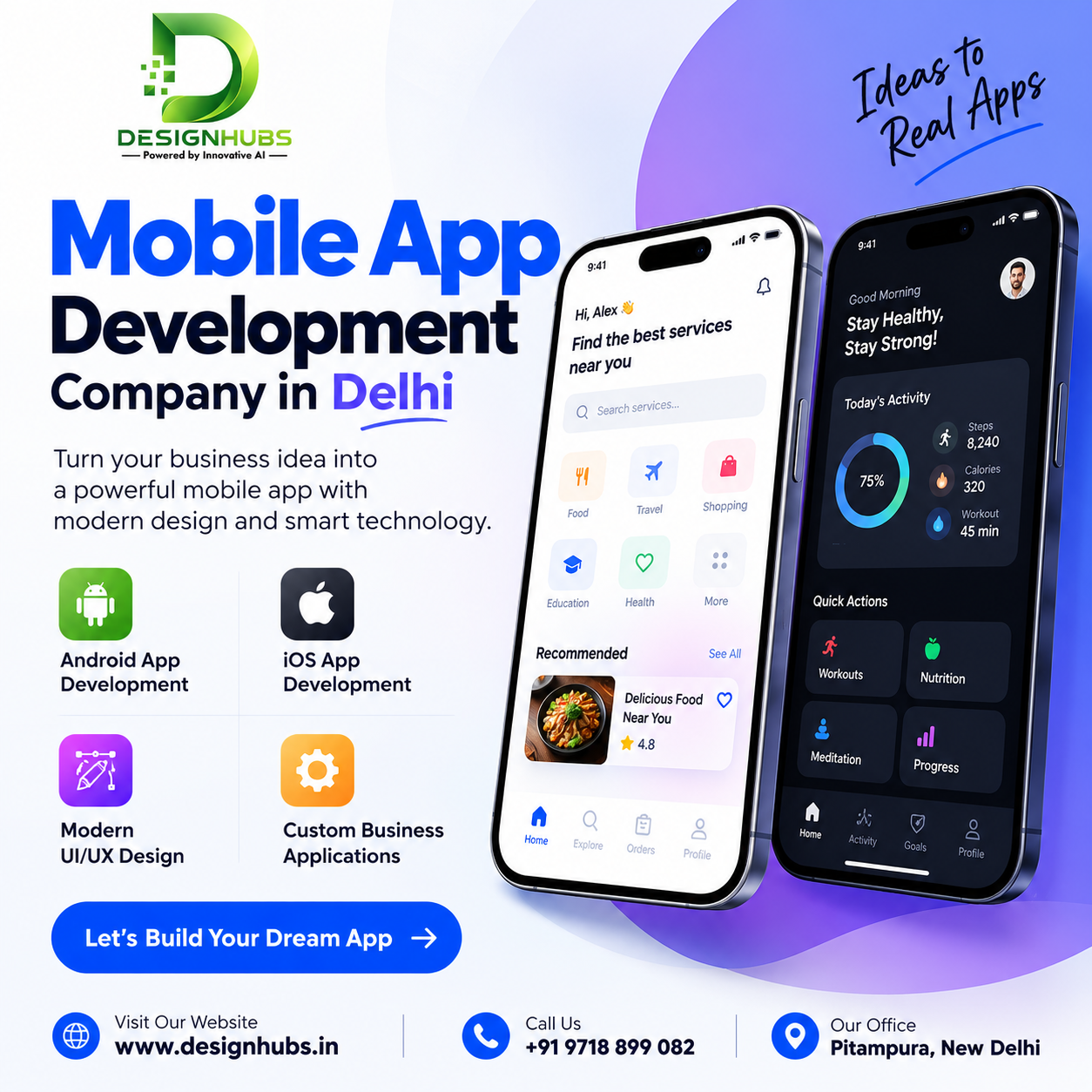
Mobile App Development Company in Delhi: A Complete Guide for Businesses
In today's digital world, mobile applications have become an important part of how businesses connect with customers, deliver services, and increase revenue. From shopping and food delivery to education, healthcare, fitness, and real estate, mobile apps are helping businesses create convenient and personalized customer experiences.
If you are searching for a mobile app development company in Delhi, choosing the right technology partner is an important step towards turning your business idea into a successful digital product.
At DesignHubs, we understand the importance of combining creative design, smooth functionality, and user-friendly digital experiences. Whether you are a startup planning your first mobile application or an established business looking to digitize your operations, the right app development strategy can help you build a stronger digital presence.
In this guide, we will explore mobile app development services, essential app features, development costs, technology choices, and how to select the right mobile app development partner for your business.
What Is Mobile App Development?
Mobile app development is the process of planning, designing, building, testing, and launching applications for smartphones and tablets.
A mobile application can help businesses showcase products, manage customer accounts, accept online payments, automate processes, send notifications, and provide services directly through mobile devices.
Depending on your business requirements, you may need an Android application, an iOS application, or a cross-platform mobile app that works on both platforms.
A well-planned application should focus on three important areas:
-
User Experience: Simple navigation and easy-to-use screens.
-
Performance: Fast loading, reliable functionality, and efficient resource usage.
-
Scalability: An architecture that can support future features and business growth.
Selecting the right approach from the beginning can reduce unnecessary development work and help you deliver a better product.
Why Does Your Business Need a Mobile App?
A mobile application can provide several benefits when it addresses a genuine customer need or business challenge.
1. Improve Customer Engagement
Mobile applications provide a direct channel for customers to interact with your business. Features such as personalized dashboards, customer accounts, in-app messaging, and relevant push notifications can help improve engagement.
For example, an educational institute can use an app to share course information, class schedules, learning resources, and student updates.
2. Simplify Business Operations
Businesses often manage customer inquiries, bookings, payments, inventory, and service requests through multiple tools.
A custom mobile application can bring these processes together in one convenient platform.
Depending on your requirements, the application may include an administrative dashboard, automated notifications, reporting tools, and integrations with existing business software.
3. Create Better Customer Experiences
Customers value convenience. A well-designed mobile app can make it easier to browse products, book appointments, track orders, access information, and communicate with your team.
A simple and intuitive interface can help customers complete their tasks with fewer unnecessary steps.
4. Support Business Growth
A mobile application can help businesses introduce new digital services, reach customers through app stores, and develop additional customer engagement channels.
However, successful growth also depends on marketing, product quality, customer support, pricing, and ongoing improvements.
5. Build a Stronger Digital Brand
A professionally designed mobile application can create a consistent brand experience through its visual identity, colours, typography, navigation, and content.
Combining mobile app development with professional UI/UX design helps businesses create digital products that look polished and are practical to use.
Mobile App Development Services for Different Business Needs
Every business has different goals, so mobile applications should be planned around specific requirements rather than a one-size-fits-all template.
Android App Development
Android applications allow businesses to serve customers using Android smartphones and tablets.
Depending on the project, development may use Kotlin, Java, Flutter, or React Native.
Android app development can be useful for:
-
E-commerce and online shopping platforms.
-
Educational applications and learning management systems.
-
Appointment booking and service applications.
-
Customer relationship management tools.
-
Business productivity and workflow applications.
iOS App Development
iOS applications are designed for Apple's mobile ecosystem, including iPhones.
Businesses targeting iPhone users may choose native iOS development or a suitable cross-platform solution.
The right technology depends on the required functionality, performance expectations, integrations, budget, and long-term maintenance plans.
Cross-Platform Mobile App Development
Cross-platform development allows businesses to build applications for Android and iOS using a shared codebase for much of the application.
Technologies such as Flutter and React Native are popular options.
This approach may reduce duplicated development work, although platform-specific features, testing, and custom integrations can still require additional effort.
Custom Mobile App Development
Custom mobile applications are designed around your business processes, target audience, and product requirements.
Examples include:
-
On-demand service applications.
-
Real estate property listing applications.
-
Healthcare appointment booking platforms.
-
E-commerce mobile applications.
-
Fitness and wellness applications.
-
Educational and online learning applications.
-
Business management and employee applications.
Before selecting a development approach, define the problem your application will solve and identify the essential features required for its first release.
Importance of UI/UX Design in Mobile App Development
User interface (UI) design focuses on the visual elements of an application, while user experience (UX) design focuses on how users interact with it.
Both are essential to creating a useful mobile application.
A visually attractive app may still perform poorly if users cannot understand its navigation or complete important tasks easily.
Professional mobile app UI/UX design typically includes:
User Research: Understanding the target audience, their needs, and common challenges.
Wireframing: Creating a basic structure for screens and navigation.
Prototyping: Building an interactive representation of the application before full development.
Visual Design: Defining layouts, typography, colours, buttons, icons, and other interface elements.
Usability Testing: Evaluating whether users can complete important tasks without confusion.
For businesses planning a new digital product, investing in UI/UX design early can help identify usability problems before they become expensive development issues.
Essential Features Every Business Mobile App Should Consider
The features of a mobile application should depend on its purpose. However, several capabilities are commonly useful.
User Registration and Login
Secure registration and authentication help users access personalized features and manage their accounts.
Easy Navigation
Clear menus, understandable labels, and consistent layouts help users find information quickly.
Payment Gateway Integration
For applications that sell products or services, payment integration can support online transactions through suitable payment providers.
Push Notifications
Notifications can inform users about relevant updates, bookings, orders, reminders, and other important events.
They should be configurable and useful rather than excessive.
Admin Dashboard
An administrative dashboard can allow authorized staff to manage users, products, content, bookings, transactions, and reports.
API Integration
APIs allow mobile applications to exchange data with backend services, databases, payment providers, and third-party business tools.
Analytics and Reporting
Analytics can help businesses understand how people use the application, identify problems, and prioritize improvements.
Security and Data Protection
Applications handling personal or financial information should use appropriate authentication, access controls, secure communication, and data-protection practices.
Not every application needs every feature. Starting with the right essentials helps control complexity and development costs.
How Much Does Mobile App Development Cost in Delhi?
The cost of developing a mobile application depends on its complexity, design requirements, technology stack, integrations, security needs, and testing requirements.
There is no single price that applies to every project.
The following figures are illustrative budgeting ranges, not verified DesignHubs quotations or fixed market prices.
| Application Type | Illustrative Budget Range |
|---|---|
| Basic application with limited features | ₹50,000–₹1,50,000 |
| Medium-complexity business application | ₹1,50,000–₹5,00,000 |
| Advanced application with multiple integrations | ₹5,00,000–₹15,00,000+ |
| Complex enterprise application | ₹15,00,000+ |
Actual costs can fall outside these ranges depending on the scope.
For example, an application with basic informational screens will generally require less development work than a platform involving real-time tracking, payment processing, multiple user roles, advanced analytics, or complex backend services.
Other potential costs include:
-
UI/UX design and prototyping.
-
Backend development and database infrastructure.
-
Third-party APIs and service subscriptions.
-
App store accounts and publishing requirements.
-
Cloud hosting, monitoring, and maintenance.
-
Future enhancements and technical support.
Before requesting a quotation, prepare a feature list and clarify whether the project includes design, backend development, testing, deployment, and post-launch maintenance.
This makes it easier to compare proposals accurately.
How Long Does It Take to Build a Mobile App?
The development timeline depends on the scope, technical complexity, team size, integrations, and feedback process.
An illustrative timeline might look like this:
| Development Stage | Estimated Duration |
|---|---|
| Requirements and planning | 1–2 weeks |
| UI/UX design | 2–4 weeks |
| Frontend and backend development | 4–12 weeks |
| Testing and quality assurance | 1–3 weeks |
| Deployment and launch preparation | 1–2 weeks |
These stages can overlap, so their durations should not simply be added together to determine the final delivery date.
A relatively simple application may take several weeks, while a complex business platform may require several months or longer.
Clear requirements, timely feedback, and early testing can help reduce avoidable delays.
How to Choose the Right Mobile App Development Company in Delhi
Choosing an app development partner involves more than comparing quotations.
Consider the following factors before making a decision.
1. Review the Portfolio
Examine previous projects to understand the company's design quality, technical capabilities, and experience with applications similar to yours.
2. Evaluate Technical Expertise
Check whether the team understands the technologies, APIs, databases, security requirements, and integrations your project needs.
3. Discuss UI/UX Design
Ask how the company approaches user research, wireframes, prototypes, responsive layouts, and usability testing.
4. Understand the Development Process
A reliable project process should include requirements gathering, milestones, progress updates, testing, and clear delivery expectations.
5. Clarify Ownership and Documentation
Confirm who will own the source code, design files, project assets, and relevant accounts after delivery.
Also clarify documentation, deployment access, and maintenance responsibilities.
6. Ask About Post-Launch Support
Mobile applications may need operating-system compatibility updates, security fixes, bug resolution, and new features.
Understand what support is included in the quotation and what will be charged separately.
7. Compare Complete Project Costs
A lower initial quotation may exclude important services such as backend development, testing, deployment, or ongoing maintenance.
Compare proposals based on the complete scope rather than price alone.
Mobile App Development Company in Pitampura, NSP, Shalimar Bagh and Rohini
Businesses in North Delhi and nearby commercial areas may be looking for a local technology partner who understands their business requirements and can communicate clearly throughout the project.
If you are searching online for a mobile app development company in Pitampura, mobile app developers near NSP, app development services in Shalimar Bagh, or a mobile application development company in Rohini, begin by reviewing the provider's portfolio, services, and project process.
Different businesses have different requirements.
For example:
-
Retail businesses may need product catalogues, customer accounts, and online ordering.
-
Coaching institutes may need student dashboards, course access, attendance, and fee management.
-
Real estate businesses may need property listings, inquiry management, and appointment booking.
-
Healthcare providers may need appointment scheduling and secure access to relevant patient information.
-
Service businesses may need booking workflows, customer notifications, and staff management.
The best solution is one that addresses your actual operational challenges and provides a clear path for future improvements.
DesignHubs is based in Pitampura, New Delhi. Businesses interested in digital design and development can explore the company's services and discuss their project requirements directly.
Our Approach to Building a Mobile Application
A structured development process helps ensure that the final application meets business and user requirements.
Step 1: Requirement Analysis
We begin by understanding your business objectives, target audience, competitors, required features, and expected outcomes.
Step 2: Planning and Technology Selection
The project scope, development approach, integrations, milestones, and technical architecture are planned according to the requirements.
Step 3: UI/UX Design
Wireframes and interface designs help establish the application's structure and user experience before implementation.
Step 4: Application Development
Developers build the application interface, backend services, database functionality, and required integrations.
Step 5: Testing and Quality Assurance
The application is tested for functionality, usability, compatibility, performance, and relevant security considerations.
Step 6: Deployment
The release process includes preparing the application for the appropriate distribution platform and completing the applicable publishing requirements.
Step 7: Maintenance and Improvements
After launch, the application can be monitored and improved using user feedback, performance data, and evolving business requirements.
The exact process and deliverables should be agreed upon before development begins.
Why Consider DesignHubs for Your Digital Project?
Choosing a digital development partner should begin with understanding whether its services match your needs.
DesignHubs focuses on creative digital experiences and web and graphic design services.
If you are planning a new digital product, the important first step is to discuss the intended features, user experience, technical requirements, budget, and expected timeline.
Before starting your project, ask for a clear scope of work, relevant portfolio examples, development milestones, and a detailed quotation.
This helps establish realistic expectations and creates a foundation for a productive working relationship.
To explore the company's work and services, visit the official website:
Website: https://designhubs.in/
Email: info@designhubs.in
Phone: +91 9718 899 082
Office: 2nd Floor, Kapil Vihar, Opposite Metro Pillar No. 354, Pitampura, New Delhi – 110034.
Frequently Asked Questions About Mobile App Development
1. Which company should I choose for mobile app development in Delhi?
Look for a company with relevant technical expertise, a suitable portfolio, transparent pricing, a defined development process, and clear post-launch support arrangements.
2. How much does it cost to develop an Android application?
The cost depends on the application's features, design, backend, integrations, and testing requirements. A detailed project scope is needed to estimate the budget accurately.
3. Can one mobile application work on both Android and iOS?
Yes. Cross-platform frameworks such as Flutter and React Native can support applications on both platforms. The most appropriate approach depends on your application's requirements.
4. What is the difference between native and cross-platform development?
Native development uses platform-specific technologies, while cross-platform development shares much of the application code across platforms. Each approach has different trade-offs involving performance, maintenance, development effort, and access to platform-specific features.
5. Do I need a backend for my mobile application?
Not always. A simple application may work without a custom backend. However, applications involving user accounts, synchronized data, payments, administrative dashboards, or business workflows generally need backend services or suitable third-party platforms.
6. Is UI/UX design necessary before mobile app development?
UI/UX design is strongly recommended for most business applications because it helps define the screen structure, navigation, and user interactions before development begins.
7. Can a mobile application be integrated with my existing website?
Yes, in many cases. API integration can allow a mobile application and website to share data and business functionality. The feasibility depends on the existing system's architecture and available interfaces.
8. How can I get a mobile app development quotation from DesignHubs?
Visit https://designhubs.in/ and contact the team with your project idea, target users, required features, preferred platforms, and estimated budget. This information can help establish the project's scope and determine the next steps.
Conclusion
A successful mobile application begins with a clear business objective, a thoughtful user experience, and an appropriate technical strategy.
Whether you are launching a startup, improving customer service, digitizing business operations, or creating a new online platform, careful planning can help you avoid unnecessary complexity and build a solution that meets your requirements.
If you are looking for a mobile app development company in Delhi, take time to evaluate technical capabilities, design quality, project scope, pricing, and long-term support before choosing your development partner.
Ready to discuss your digital project?
Visit DesignHubs to explore its services and get in touch with the team about your business requirements.