
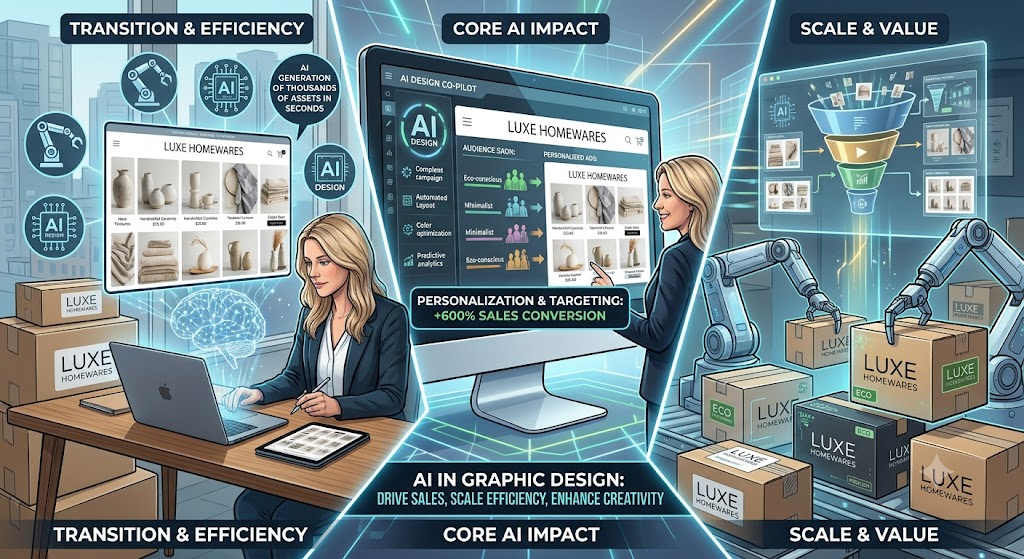
The Big Question
Is AI replacing graphic designers, or is it replacing the waiting?
That's the question I ask every client who comes to us wanting "AI design." The answer depends entirely on what they think design is. If they think design is the production of pixels—resizing images, swapping colors, localizing banners—then yes, AI is replacing that. If they think design is the act of deciding what should be communicated and why, then AI is not replacing anything. It's removing the friction that kept designers from doing more of it.
The data tells a striking story. In Q1 2026, 91% of tech designers used AI for design tasks at least weekly, up from just 54% a year earlier . That's a 37-percentage-point jump in twelve months. Daily usage hit 75%. The toolstack itself expanded—designers who used an average of three tools a year ago now juggle seven .
But adoption isn't the same as transformation. What's actually changing for businesses is more specific. It's happening in three places: speed, brand consistency, and the cost of variation. And it's creating a new kind of designer—one whose value isn't in output, but in the workflows they build.
What AI Is Actually Changing (And What It Isn't)
Speed: From Days to Minutes
The most visible shift is velocity. Tasks that once consumed hours of manual labor now happen in seconds.
Superside, a creative-as-a-service company, reported reducing design costs for clients by more than $1.4 million by integrating AI into their processes. In one project, they delivered over 200 high-quality visuals under a tight deadline, reducing design hours by about 87% compared to conventional methods . Another project produced 75 unique ad designs—triple their typical output for the same budget and timeline .
This isn't about replacing designers. It's about removing the production ceiling. When a business needs fifty variations of a banner for different audiences, AI can generate them. When a campaign needs localization across ten markets, AI can adapt layouts and text. The human still decides which version is right. The human still catches the errors. But the human no longer spends their day on repetitive execution.
Brand Consistency: The Brand Kit Solution
The biggest friction in AI-powered creative work has always been the gap between AI output and brand-ready asset. You get a draft or an image, and then you spend time manually applying fonts, colors, and visual standards before it's usable.
Canva has attacked this directly. Their Brand Kit function, now integrated with every major AI platform—Claude, ChatGPT, Copilot, and Gemini—allows organizations to set guidelines around AI-generated assets so they meet existing brand standards from the first prompt . As Canva's general manager of ecosystem put it: "Every design generated inside Gemini already can reflect the organization's visual guidelines from the first prompt, no tedious corrections needed" .
Adobe is taking a similar but more technical route. Firefly inside Illustrator can generate editable vector artwork from text prompts, then let designers reshape, restyle, and recolor it with full control. The AI Assistant automates versioning and localization—generating market-specific variations from a master design, flagging text overflow, and maintaining layouts while keeping files non-destructive .
For businesses, this means something practical: brand guidelines stop being a document nobody reads and become infrastructure baked into the tools. The result is less time correcting off-brand output and more time deciding what to create.
Variation at Scale: The Real Business Value
The most underrated transformation isn't speed or brand safety. It's the ability to explore more directions before committing.
Before AI, testing five different design concepts meant paying for five different concepts. Most businesses tested one, maybe two, and hoped for the best. Now, AI can generate dozens of variations in the time it used to take to produce one. Designers can explore more, discard faster, and refine the strongest concepts with human judgment .
This changes the economics of creative work. The cost of being wrong drops. The cost of exploring drops. And the cost of producing the final, polished asset—the one that actually ships—stays roughly the same, because that part still requires human judgment, taste, and quality control.
The Tools Shaping 2026 (And What They're Actually For)
The AI design tool market has consolidated around a few major players, each with a distinct philosophy.
Adobe Firefly leads with roughly 29% market share among AI design tools . Its strength is depth. Firefly is embedded inside Photoshop, Illustrator, InDesign, and Premiere Pro, which means AI-generated assets stay editable and consistent across the entire Creative Cloud ecosystem. For enterprises with established design systems, this integration is the selling point. You're not generating disposable images; you're generating production-ready components that flow through existing workflows .
Canva holds about 16% market share , but its strategy is different. Canva's strength is access. By integrating with every major AI assistant—Gemini, ChatGPT, Copilot, Claude—Canva meets users where they already work . Its AI 2.0 release leans into prompt-based editing, making design feel like a conversation rather than a process . For businesses without dedicated design teams, this is transformative. A marketing manager can generate a brand-compliant social post without opening a design tool at all.
Midjourney sits at 19% market share , serving a different need entirely: exploration and high-fidelity concept generation. It's less about production workflows and more about discovering visual directions that didn't exist before.
The tool you choose matters less than the question you ask it. Are you trying to execute faster within an existing system? Adobe. Are you trying to empower non-designers to create on-brand assets? Canva. Are you exploring new creative territory? Midjourney. Most businesses need a combination, not a single winner.
The New Designer: From Maker to Toolmaker
The most important shift isn't in the tools. It's in the role of the designer.
The AI in Design 2026 report, based on a survey of over 900 designers, found that the most sought-after practitioners are no longer evaluated solely on their output. They're evaluated on the workflows they build—microtools, agentic pipelines, internal automation—that extend their leverage across a team . Half of surveyed designers have shipped code to production, driven by AI coding tools that lower the technical floor .
This is a structural change. A designer who builds a brand-aware prototyping tool that any product manager can use without design involvement is doing something fundamentally different from a designer whose value is in their personal output. Both will exist. But the first is scalable in a way the second is not.
For businesses, this means the question "should we hire a designer or use AI?" is the wrong question. The right question is: do we have someone who can design the system that produces consistent, on-brand output at scale? That person is more valuable than ever. The person whose only skill was executing production tasks is facing a harder market.
What This Costs (And What It Saves)
The financial picture is genuinely mixed, and I won't pretend otherwise.
On the savings side: Superside's $1.4 million reduction in client design costs and 87% reduction in design hours for specific projects are real numbers from a real agency . The generative AI in graphic design market reached **$993.9 million in 2025** and is projected to grow at 32.75% annually through 2035 . Businesses are investing because the returns are measurable.
On the cost side: AI design tools aren't free. Adobe Firefly subscriptions start around $5 per month** for basic access, but professional Creative Cloud plans run significantly higher . Canva's paid plans start around **$15 per month . Enterprise integrations, custom brand kit setups, and workflow automation require investment in both tools and the people who know how to configure them.
The real cost shift is in what you're paying for. You're paying less for execution and more for judgment. Less for production hours and more for the systems that make production efficient. Businesses that understand this distinction will extract value from AI design. Those that expect AI to replace thinking will get exactly what they pay for: cheap output that looks like cheap output.
The Risks Nobody Talks About
I'd be doing you a disservice if I only talked about the upside.
Brand drift. When anyone can generate a design, anyone can generate an off-brand design. Canva's Brand Kit and Adobe's brand libraries help, but they're only as good as the guidelines behind them. Without strict governance, AI accelerates inconsistency.
The authenticity problem. Research on generative AI in branding notes ethical concerns around copyright ambiguity and the importance of human-AI collaboration . AI-generated visuals can feel hollow when they replace genuine human creativity. The businesses that win will use AI for execution and humans for the ideas that actually matter.
The skills gap. The same report that shows 91% weekly AI adoption also shows that enterprise designers at large companies (2,000+ employees) are far more likely to use internal AI tools (74%) than designers at small organizations (26%) . Small businesses risk falling behind because they lack the infrastructure to build custom workflows. This is where partners matter. You don't need to build everything yourself.
What We Offer
We don't sell "AI design." We build design systems that use AI where it helps and human judgment where it matters.
That means we help businesses set up brand-compliant AI workflows, integrate tools like Canva and Adobe into existing processes, and train teams to use AI for execution without losing control of the output. We've spent five years building AI solutions, and we've learned that the technology is only as good as the strategy behind it.
If you're wondering how AI fits into your design process—or whether it should—start a conversation with us at DesignHubs. We'll tell you what's worth automating and what isn't.
Frequently Asked Questions
Will AI replace graphic designers?
Not the ones who think. AI is replacing production tasks—resizing, variations, basic editing—but the judgment, taste, and strategic thinking behind good design remain human. The designers most at risk are those whose value was purely execution.
What's the biggest benefit of AI design for a small business?
Access. Tools like Canva integrated with AI assistants let small teams produce on-brand assets without hiring a full design department. The barrier to professional-looking output has dropped dramatically.
How do I keep AI-generated designs on-brand?
Set up brand kits in your tools (Canva, Adobe) with locked fonts, colors, and logo usage rules. Train everyone who generates assets on those guidelines. AI will follow the rules you give it—or ignore them if you haven't set any.
Is AI-generated design copyright-safe?
This is still evolving legally. Adobe Firefly is trained on licensed content and designed to be commercially safe for most uses. Other tools vary. For business-critical assets, check the tool's terms and consider human-created or heavily human-edited work.
What should I look for in an AI design partner?
Someone who asks about your brand guidelines before showing you tools. Someone who talks about workflows, not just outputs. And someone who can tell you honestly when AI is the wrong solution for your problem.
Tagline
AI doesn't design. It removes the reasons you couldn't.
— DesignHubs, where automation meets judgment.
Here are 6 different Meta Description options for "How AI Is Transforming Graphic Design for Businesses":
Option 1 (Benefit-led):
See how AI is reshaping graphic design for businesses in 2026—faster asset creation, brand-safe automation, and what it really costs, from a 5-year AI CEO.
Option 2 (Question hook):
Is AI replacing graphic designers or just the busywork? A 5-year AI CEO breaks down how AI is transforming business design in 2026—and what to watch for.
Option 3 (Data-driven):
91% of designers now use AI weekly. A 5-year AI CEO explains how AI is transforming graphic design for businesses—speed, brand consistency, and cost realities.
Option 4 (Practical angle):
How AI is transforming graphic design for businesses in 2026: real workflows, brand-safe tools, cost shifts, and the risks—straight from a 5-year AI CEO.