
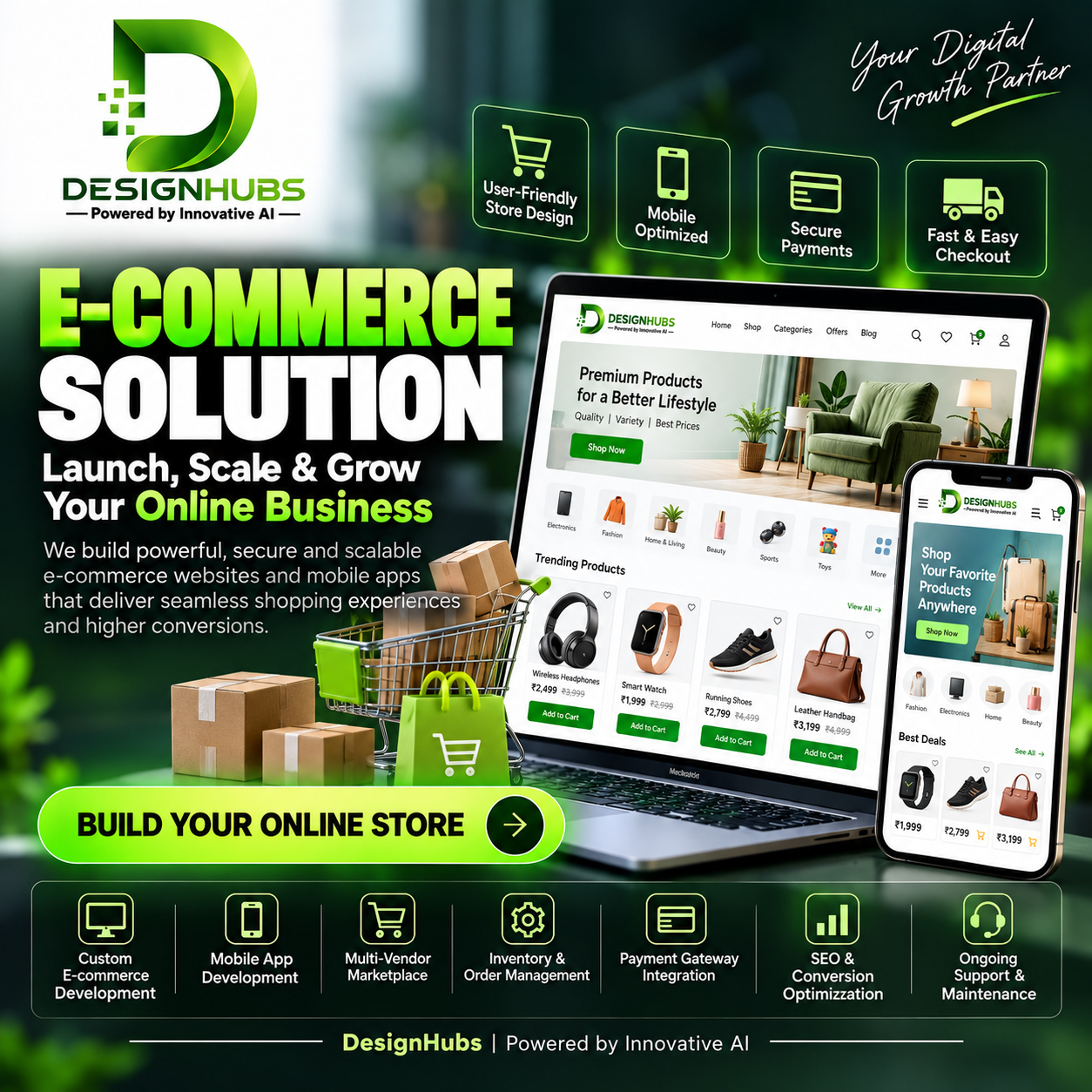
E-commerce Solution & E-commerce Website Development Services
Build a Professional Online Store That Helps Your Business Sell Online
The way customers shop has changed significantly. Today, people search for products online, compare prices, check reviews, explore product information, and complete purchases from smartphones, tablets, and computers. For businesses, having a professional e-commerce website is no longer simply an additional marketing channel. It can become an important part of the overall sales and customer experience.
At DesignHubs, we provide professional E-commerce Solutions and E-commerce Website Development Services for startups, small businesses, growing brands, retailers, manufacturers, D2C businesses, B2B companies, and established enterprises.
Our e-commerce solutions are designed around your products, customers, business model, brand identity, and growth objectives. From a small online store with a limited product catalogue to a larger e-commerce platform with advanced integrations, we can help you plan, design, develop, optimize, and maintain your online store.
A successful e-commerce website requires more than attractive product images. It needs an organized product catalogue, intuitive navigation, responsive design, secure checkout, convenient payment options, shipping functionality, inventory management, SEO-friendly architecture, analytics, and a smooth customer journey.
At DesignHubs, we combine e-commerce website design, web development, UI/UX, SEO, payment integration, product management, performance optimization, and digital solutions to create online stores that are designed for real business requirements.
Whether you want to launch your first online store, redesign an existing e-commerce website, migrate your store to another platform, or develop a custom e-commerce solution, our team can help you choose and implement the right approach.
What Is an E-commerce Solution?
An e-commerce solution is a complete digital system that allows a business to sell products or services online.
It can include much more than the front-end website customers see.
A complete e-commerce solution may include:
-
Online storefront
-
Product catalogue
-
Category management
-
Product search
-
Product filters
-
Product variations
-
Shopping cart
-
Wishlist
-
Customer accounts
-
Checkout
-
Payment gateway
-
Shipping integration
-
Order management
-
Inventory management
-
Coupon and discount management
-
Tax configuration
-
Invoice generation
-
Customer notifications
-
Analytics
-
CRM integration
-
ERP integration
-
Marketing integration
-
SEO
-
Website security
-
Website maintenance
The exact features depend on your business model and requirements.
For example, a fashion brand may need product variations such as size and color, while a B2B business may require bulk ordering, customer-specific pricing, quotation requests, and account-based purchasing.
This is why choosing the right e-commerce solution should begin with understanding the business rather than simply selecting a template.
Professional E-commerce Website Development Services
DesignHubs provides end-to-end e-commerce website development solutions designed to help businesses establish and manage their online stores.
1. Custom E-commerce Website Design
Your online store represents your brand.
A generic or poorly structured design can make it difficult for customers to understand your products and complete purchases.
Our custom e-commerce website design focuses on:
-
Brand identity
-
Product presentation
-
Easy navigation
-
Clear calls to action
-
Mobile responsiveness
-
User-friendly layouts
-
Product discovery
-
Trust-building elements
-
Simple checkout experience
We can create a unique design based on your brand colors, typography, product categories, target customers, and business objectives.
2. E-commerce Website Development
Our e-commerce development services transform the approved design and business requirements into a functional online store.
Depending on the project, development can include:
-
Frontend development
-
Backend development
-
Product management
-
Database integration
-
Customer accounts
-
Shopping cart
-
Checkout
-
Payment integration
-
Order management
-
Inventory functionality
-
Admin dashboard
-
API integrations
-
Third-party integrations
-
Analytics
-
SEO configuration
The technology and architecture can be selected according to the size and complexity of your business.
3. B2C E-commerce Solutions
B2C or Business-to-Consumer e-commerce allows businesses to sell directly to individual customers.
A B2C online store can include:
-
Product catalogue
-
Product search
-
Product filters
-
Product variations
-
Customer accounts
-
Shopping cart
-
Wishlist
-
Online payment
-
Coupon codes
-
Order tracking
-
Reviews
-
Product recommendations
-
Customer notifications
The primary focus is usually creating a simple and convenient shopping experience.
4. B2B E-commerce Solutions
B2B businesses often require different functionality compared with consumer-focused online stores.
A B2B e-commerce solution may include:
-
Business customer accounts
-
Bulk ordering
-
Wholesale pricing
-
Customer-specific pricing
-
Minimum order quantities
-
Quote requests
-
Purchase order workflows
-
Credit limits
-
Account dashboards
-
Order history
-
Invoice management
-
Multiple users per company
-
CRM integration
-
ERP integration
A custom B2B e-commerce solution can help businesses manage digital sales while supporting existing operational workflows.
5. D2C E-commerce Website Development
Direct-to-consumer brands sell products directly to customers through their own digital channels.
A D2C website can help brands control:
-
Customer experience
-
Product presentation
-
Branding
-
Customer data
-
Marketing campaigns
-
Promotions
-
Customer communication
-
Loyalty programs
-
Repeat purchases
For D2C businesses, the website should be designed around the entire customer journey, from product discovery to checkout and post-purchase communication.
6. E-commerce Website Redesign
Already have an online store but not satisfied with its performance or appearance?
An e-commerce redesign can help modernize your existing store.
A redesign may include:
-
New homepage design
-
Improved product pages
-
Better category navigation
-
Mobile optimization
-
Updated branding
-
Improved checkout
-
Better product filtering
-
Speed optimization
-
SEO improvements
-
Better calls to action
-
Improved trust elements
We can review your existing e-commerce website and identify areas that can be improved based on your business goals.
7. E-commerce Migration Services
Businesses may need to migrate their store from one platform to another because of changing business requirements.
Migration can involve moving:
-
Products
-
Categories
-
Customers
-
Orders
-
Images
-
Content
-
URLs
-
Product variations
-
Inventory
-
SEO data
A migration should be carefully planned to minimize data loss, broken links, SEO issues, and disruption to customers.
8. Product Catalogue Management
A well-organized catalogue makes it easier for customers to discover and compare products.
An e-commerce catalogue can include:
-
Product names
-
Product descriptions
-
Product images
-
Pricing
-
SKU
-
Categories
-
Subcategories
-
Attributes
-
Variations
-
Stock information
-
Product specifications
-
Reviews
-
Related products
A structured product catalogue can also support SEO and internal search.
9. Shopping Cart Development
The shopping cart is an important part of the customer journey.
A user-friendly cart should clearly display:
-
Selected products
-
Quantity
-
Product price
-
Discounts
-
Taxes
-
Shipping charges
-
Total amount
-
Coupon options
-
Checkout button
Customers should be able to easily update quantities, remove products, and continue shopping.
10. Secure Checkout Development
A complicated checkout process can create unnecessary friction.
An effective checkout experience should make it easy for customers to:
-
Enter their information
-
Select an address
-
Choose a shipping option
-
Select payment method
-
Review their order
-
Complete payment
-
Receive confirmation
Depending on the business model, checkout can support guest checkout, customer accounts, saved addresses, multiple payment methods, coupons, shipping options, and other features.
11. Payment Gateway Integration
Online stores need reliable payment options so customers can complete purchases conveniently.
Depending on the business and platform, payment integrations may support:
-
UPI
-
Debit cards
-
Credit cards
-
Net banking
-
Digital wallets
-
International cards
-
Cash on Delivery
-
EMI options
Payment gateway integration depends on the selected payment provider, business requirements, compliance requirements, and e-commerce platform.
Popular payment providers used by Indian e-commerce businesses include options such as Razorpay, PayU, Cashfree and others.
12. Shipping and Delivery Integration
An online store also needs an efficient order fulfilment process.
Shipping functionality can include:
-
Shipping zones
-
Delivery charges
-
Pincode serviceability
-
Shipping rules
-
Courier integration
-
Order tracking
-
Delivery notifications
-
Shipping labels
-
Return workflows
Courier and shipping aggregator integrations can help businesses connect their online store with fulfilment operations.
13. Inventory Management
Inventory management becomes increasingly important as the number of products and orders grows.
An e-commerce inventory system can help manage:
-
Stock levels
-
Product quantities
-
SKU
-
Low-stock alerts
-
Product availability
-
Variations
-
Warehouse stock
-
Inventory updates
-
Order-related stock changes
For larger businesses, inventory can also be connected with ERP, POS, or other operational systems. Modern e-commerce solutions commonly integrate inventory and order workflows with other business systems.
14. Order Management System
A centralized order management system helps businesses manage customer orders after checkout.
Depending on requirements, an admin dashboard can provide:
-
New orders
-
Processing orders
-
Shipped orders
-
Delivered orders
-
Cancelled orders
-
Returned orders
-
Payment status
-
Shipping status
-
Customer information
-
Invoice information
This gives the business greater visibility into its online sales operations.
15. Customer Account Management
Customer accounts can make repeat purchases easier.
Features can include:
-
Registration
-
Login
-
Password reset
-
Profile management
-
Saved addresses
-
Order history
-
Wishlist
-
Saved payment preferences
-
Reorder options
The exact features depend on the store's business model.
16. Wishlist Functionality
A wishlist allows customers to save products for later.
This can be useful for customers who are not ready to purchase immediately.
Wishlist functionality can support:
-
Product saving
-
Future purchases
-
Customer engagement
-
Product discovery
-
Personalized marketing
For some businesses, wishlist activity can also support remarketing strategies.
17. Product Search and Filters
For stores with many products, search and filters are essential.
Customers may want to filter products by:
-
Price
-
Brand
-
Category
-
Size
-
Color
-
Material
-
Rating
-
Availability
-
Product type
A well-designed search and filtering system can help customers find products faster.
18. Coupon and Discount Management
E-commerce websites can provide promotional tools for marketing campaigns.
These may include:
-
Coupon codes
-
Percentage discounts
-
Flat discounts
-
First-order offers
-
Category discounts
-
Product-specific offers
-
Minimum order discounts
-
Seasonal offers
-
Free shipping offers
Promotional functionality can be connected with marketing campaigns and customer segments.
19. Product Reviews and Ratings
Product reviews can provide customers with additional information when evaluating products.
Review functionality may allow customers to:
-
Submit ratings
-
Write reviews
-
Upload images
-
Read previous reviews
Businesses can also implement moderation and review management through the admin dashboard.
20. E-commerce SEO Services
SEO is an important part of building long-term organic visibility for an online store.
An SEO-friendly e-commerce website can include:
-
Clean URLs
-
Optimized category pages
-
Product page optimization
-
Meta titles
-
Meta descriptions
-
Heading structure
-
Image optimization
-
Internal linking
-
XML sitemap
-
Product structured data
-
Breadcrumbs
-
Canonical URLs
-
Mobile optimization
-
Fast page performance
E-commerce SEO should consider both users and search engines.
Product and category pages can be structured so search engines can better understand the store's content and product offerings. E-commerce development providers commonly include clean URLs, product schema, sitemaps, and other SEO foundations in store builds.
Mobile-Friendly E-commerce Website Design
A large number of customers browse and shop using smartphones.
This makes mobile-first design particularly important for e-commerce businesses.
A mobile-friendly store should provide:
-
Responsive layouts
-
Easy navigation
-
Readable product information
-
Mobile-friendly filters
-
Easy add-to-cart functionality
-
Simple checkout
-
Optimized images
-
Fast page loading
-
Touch-friendly buttons
The complete customer journey should be tested on different screen sizes before launch.
E-commerce Website Speed Optimization
Website performance can affect user experience and conversion opportunities.
A slow online store can make it difficult for users to browse products and complete purchases.
Performance optimization may include:
-
Image compression
-
Modern image formats
-
Lazy loading
-
Code optimization
-
Caching
-
CDN configuration
-
Database optimization
-
Script optimization
-
CSS optimization
-
Reducing unnecessary third-party resources
Performance should be considered during development rather than only after the website has been launched.
E-commerce Analytics and Tracking
Data can help businesses understand how customers interact with their online store.
Analytics can provide information about:
-
Website visitors
-
Product views
-
Add-to-cart activity
-
Checkout activity
-
Purchases
-
Revenue
-
Traffic sources
-
Campaign performance
-
Customer behavior
E-commerce tracking can help businesses