
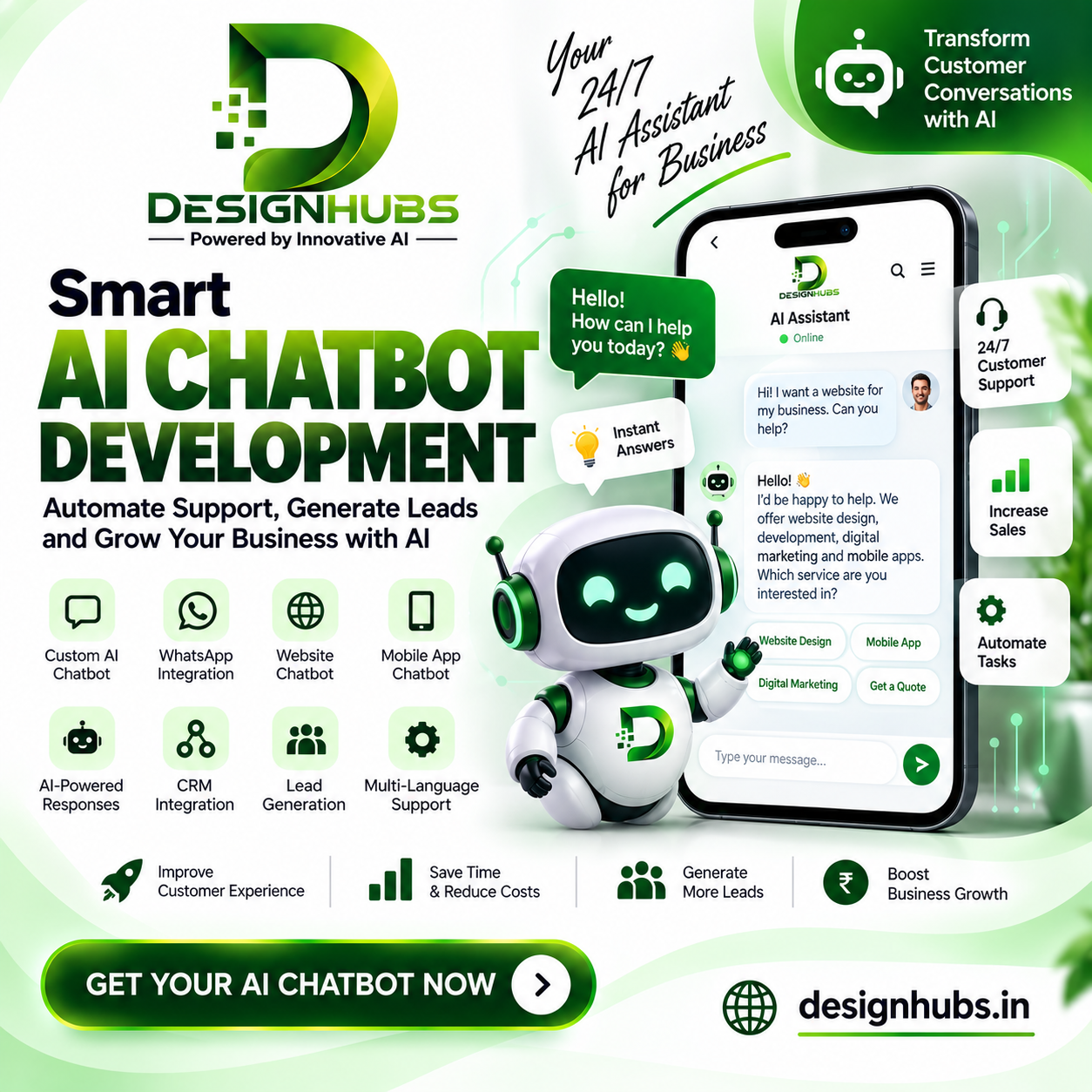
AI Chatbot Development Services: Smart AI Chatbots for Business Growth
In today’s digital-first business environment, customers expect fast, accurate, and personalized communication. They want answers immediately—whether they are looking for product information, checking an order, asking about services, booking an appointment, or requesting support. This is where AI chatbot development services can transform the way businesses communicate with their customers.
An AI chatbot is an intelligent software solution that uses technologies such as Artificial Intelligence (AI), Natural Language Processing (NLP), Machine Learning, and automation to communicate with users through websites, mobile applications, WhatsApp, social media, and other digital platforms.
Businesses across industries are adopting AI chatbot solutions to automate customer support, generate leads, improve sales, provide 24/7 assistance, and reduce repetitive manual work.
If you are looking for a reliable AI chatbot development company, DesignHubs provides customized chatbot development solutions designed around your business requirements, customer journey, and operational goals.
What Is an AI Chatbot?
An AI chatbot is a software application that can understand user questions and respond automatically using artificial intelligence.
Unlike traditional rule-based chatbots that can only respond to predefined commands, modern AI chatbots can understand natural language and handle more flexible conversations.
For example, a customer may type:
“Can you tell me the price of your website development package?”
Instead of requiring the customer to select a predefined option, an AI chatbot can understand the question, identify the customer's intent, and provide an appropriate response.
AI chatbots can be integrated with:
-
Business websites
-
Mobile applications
-
WhatsApp
-
Facebook Messenger
-
CRM systems
-
E-commerce platforms
-
Customer support systems
-
Booking systems
-
Lead management platforms
-
Enterprise software
-
Internal business portals
A professionally developed chatbot can become more than a customer-support tool. It can work as a virtual sales assistant, lead-generation assistant, customer service agent, appointment assistant, product recommendation engine, and business automation solution.
Why Businesses Need AI Chatbot Development
Customers do not want to wait several hours for a response to a simple question. At the same time, businesses cannot always keep customer-support representatives available 24/7.
AI chatbots help solve this challenge by providing automated assistance at any time.
A chatbot can answer frequently asked questions, collect customer information, qualify leads, provide product details, schedule appointments, and transfer complex queries to human agents.
For businesses, this means fewer repetitive tasks for employees and faster communication with customers.
Key reasons businesses invest in AI chatbots include:
-
24/7 customer support
-
Faster response times
-
Automated lead generation
-
Improved customer engagement
-
Reduced repetitive support work
-
Better sales conversion opportunities
-
Personalized customer communication
-
Automated appointment booking
-
CRM integration
-
WhatsApp automation
-
Website visitor engagement
-
Multilingual customer support
-
Data collection and analytics
The right chatbot strategy depends on the company's industry, customer journey, existing technology infrastructure, and business objectives.
AI Chatbot Development Services
As an experienced AI chatbot development company, DesignHubs can help businesses plan, design, develop, integrate, and maintain intelligent chatbot solutions.
Our chatbot development process can be customized according to the business model and target audience.
1. Custom AI Chatbot Development
Every business has different requirements. A generic chatbot may not provide the functionality your business needs.
Custom AI chatbot development allows businesses to build a chatbot specifically around their products, services, workflows, FAQs, customer journey, and internal processes.
A custom chatbot can include:
-
Personalized conversation flows
-
Business-specific knowledge
-
Lead forms
-
Product information
-
Customer support
-
Automated notifications
-
CRM integration
-
Payment integration
-
Appointment scheduling
-
Human-agent transfer
-
Analytics dashboards
Custom development also allows businesses to add new functionality as they grow.
2. AI-Powered Customer Support Chatbots
Customer support is one of the most common applications of AI chatbots.
Instead of requiring employees to answer the same questions repeatedly, an AI chatbot can handle common customer queries automatically.
For example, a chatbot can answer questions related to:
-
Product availability
-
Pricing
-
Delivery
-
Returns
-
Refunds
-
Business hours
-
Services
-
Locations
-
Account information
-
Order status
-
Appointment details
When a question requires human intervention, the chatbot can transfer the conversation to a customer-support representative.
This creates a combination of AI automation and human support.
3. AI Lead Generation Chatbot
Generating and qualifying leads is an important objective for many businesses.
A website visitor may be interested in a service but leave the website without submitting a contact form.
An AI chatbot can engage visitors proactively and ask relevant questions.
For example:
“Are you looking for a website, mobile app, CRM, or AI solution?”
The chatbot can then collect:
-
Name
-
Phone number
-
Email address
-
Company name
-
Required service
-
Budget range
-
Project requirements
-
Preferred contact time
The collected information can be sent directly to a CRM or sales team.
This allows businesses to respond to potential customers more quickly.
4. AI Sales Chatbot
An AI chatbot can also work as a virtual sales assistant.
It can help customers understand products and services, recommend relevant options, answer pricing questions, and guide users toward a purchase or inquiry.
For e-commerce businesses, a chatbot can help customers find products based on their requirements.
For service businesses, it can identify what type of service the customer needs and collect information for the sales team.
This can help create a smoother customer journey from first interaction to lead conversion.
5. Website AI Chatbot Development
A website chatbot can be integrated directly into your website.
Instead of forcing visitors to search through multiple pages, the chatbot can provide quick answers and guide users to relevant information.
A website AI chatbot can help with:
-
Product information
-
Service information
-
Pricing queries
-
Lead generation
-
FAQs
-
Contact requests
-
Appointment booking
-
Customer support
-
Navigation
-
Sales assistance
A professionally designed chatbot should match the website's branding and provide a simple, user-friendly experience.
6. WhatsApp AI Chatbot Development
WhatsApp is widely used by businesses for customer communication.
A WhatsApp AI chatbot can automate conversations while allowing businesses to maintain communication through a familiar messaging platform.
Businesses can use WhatsApp chatbots for:
-
Customer inquiries
-
Lead generation
-
Order notifications
-
Appointment reminders
-
Product information
-
Customer support
-
Marketing communication
-
Booking requests
-
Follow-ups
WhatsApp chatbot development can be particularly useful for businesses that already receive a large number of customer inquiries through WhatsApp.
7. AI Chatbot for E-Commerce
E-commerce websites receive thousands of customer questions related to products, delivery, pricing, returns, and order status.
An AI chatbot can automate many of these interactions.
For example, a customer can ask:
“Which laptop is suitable for graphic designing under my budget?”
The chatbot can use available product information to provide relevant recommendations.
An e-commerce chatbot can assist with:
-
Product discovery
-
Product recommendations
-
Order tracking
-
Returns
-
Refund queries
-
Shipping information
-
Product comparisons
-
Frequently asked questions
-
Customer support
When integrated with an e-commerce platform, the chatbot can become an important part of the customer experience.
8. AI Chatbot for Real Estate
Real estate companies receive leads from websites, advertisements, social media, and property portals.
Responding to every inquiry manually can take significant time.
A real estate AI chatbot can automatically collect information such as:
-
Preferred location
-
Property type
-
Budget
-
Number of bedrooms
-
Buying or renting requirement
-
Preferred property size
-
Contact details
The chatbot can then help the sales team identify relevant leads.
It can also answer basic property-related questions and schedule calls or site visits.
This makes AI chatbot development for real estate a useful solution for automating lead qualification and customer communication.
9. AI Chatbot for Healthcare
Healthcare organizations can use AI chatbots to provide general information and support administrative processes.
A healthcare chatbot may assist with:
-
Appointment scheduling
-
Doctor availability
-
Hospital information
-
Department information
-
General FAQs
-
Appointment reminders
-
Patient communication
-
Navigation within healthcare services
Healthcare chatbots should be designed carefully, particularly when handling sensitive information. Medical diagnosis or treatment recommendations should not be presented as a substitute for qualified medical professionals.
10. AI Chatbot for Education
Schools, colleges, universities, and educational institutions can use AI chatbots to automate student and parent communication.
An education chatbot can provide information about:
-
Courses
-
Admissions
-
Fees
-
Class schedules
-
Programs
-
Campus information
-
Application processes
-
Events
-
Frequently asked questions
It can also collect admission inquiries and forward qualified leads to the admissions team.
11. AI Chatbot for Banking and Finance
Financial organizations can use AI chatbots for customer-service and informational workflows.
Possible applications include:
-
General account FAQs
-
Product information
-
Service information
-
Branch information
-
Application status
-
Support requests
-
Customer guidance
Because financial data is sensitive, chatbot solutions for this sector require strong security, authentication, access controls, and compliance considerations.
12. AI Chatbot for Travel and Hospitality
Hotels, travel companies, and tourism businesses can use AI chatbots to improve customer communication.
A travel chatbot can help users with:
-
Hotel information
-
Booking inquiries
-
Travel packages
-
Destination information
-
Check-in information
-
FAQs
-
Reservation assistance
-
Customer support
A chatbot can remain available even outside normal business hours, allowing customers to receive immediate responses.
AI Chatbot Features
Modern AI chatbot solutions can include a wide range of features depending on business requirements.
Natural Language Understanding
The chatbot can understand natural language rather than requiring customers to use exact predefined commands.
Context-Aware Conversations
Advanced chatbots can maintain conversation context so users do not have to repeat information unnecessarily.
Lead Capture
The chatbot can collect customer details and send them to a CRM or sales team.
CRM Integration
Chatbots can integrate with CRM systems to create leads, update records, and support sales workflows.
Human Handoff
When a chatbot cannot resolve an issue, the conversation can be transferred to a human agent.
Multilingual Support
Businesses serving multiple regions can implement multilingual chatbot functionality.
Analytics
Chatbot dashboards can provide information about:
-
Number of conversations
-
Common questions
-
Lead volume
-
Customer engagement
-
Conversion events
-
Response performance
Knowledge Base Integration
An AI chatbot can be connected with business information, documents, FAQs, product catalogs, and other approved knowledge sources.
AI Chatbot with CRM Integration
One of the most valuable chatbot integrations for businesses is CRM connectivity.
A chatbot can automatically send customer information to a CRM whenever a visitor submits an inquiry.
For example:
Website Visitor → AI Chatbot → Lead Qualification → CRM → Sales Team
This can reduce manual data entry and help sales teams follow up with leads more efficiently.
CRM integration can support:
-
Lead creation
-
Customer information
-
Conversation history
-
Lead status
-
Follow-up reminders
-
Sales pipeline management
For companies already using CRM software, chatbot integration can help connect customer communication with internal sales processes.
AI Chatbot Development Process
A successful chatbot requires more than simply adding an AI model to a website.
A structured development process helps ensure that the chatbot serves a clear business purpose.
Step 1: Requirement Analysis
The first step is understanding the business.
We identify:
-
Business objectives
-
Target audience
-
Customer problems
-
Existing systems
-
Required integrations
-
Expected chatbot functionality
Step 2: Conversation Design
The next step is designing the chatbot conversation flow.
This includes determining:
-
How the chatbot should greet users
-
What questions it should ask
-
How it should respond
-
When it should collect information
-
When it should transfer users to human support
Step 3: UI/UX Design
The chatbot interface should be simple and consistent with the company's branding.
Important elements include:
-
Chat window
-
Buttons
-
Forms
-
Quick replies
-
Typing indicators
-
Error handling
-
Mobile responsiveness
Step 4: AI Development
The AI layer is developed according to the chatbot's purpose.
Depending on requirements, this may involve:
-
NLP
-
Machine learning
-
Large language models
-
Retrieval-augmented generation
-
Knowledge bases
-
Intent detection
-
Context management
Step 5: API and System Integration
The chatbot can be integrated with existing systems such as:
-
CRM
-
ERP
-
E-commerce platforms
-
Databases
-
Payment systems
-
Booking systems
-
WhatsApp
-
Websites
-
Mobile apps
Step 6: Testing
The chatbot is tested against different questions and scenarios.
Testing can identify:
-
Incorrect answers
-
Broken conversation flows
-
Integration problems
-
Unexpected user inputs
-
Security issues
Step 7: Deployment
After testing, the chatbot is deployed to the required platform.
Step 8: Monitoring and Improvement
AI chatbot development is not necessarily a one-time process.
Businesses can continuously improve their chatbot using conversation analytics and customer feedback.
Benefits of AI Chatbot Development for Businesses
24/7 Availability
Unlike traditional support teams, AI chatbots can remain available around the clock.
Faster Customer Responses
Customers can receive immediate answers to common questions.
Reduced Repetitive Work
Employees can spend less time answering repetitive queries.
Improved Lead Management
Chatbots can collect and qualify leads automatically.
Better Customer Engagement
Interactive conversations can help businesses engage website visitors more effectively.
Scalable Customer Support
A chatbot can handle multiple conversations simultaneously, subject to the underlying system's capacity and configuration.
Personalized Communication
AI can use available customer and conversation context to provide more relevant responses.
Business Automation
Chatbots can become part of broader business automation workflows.
AI Chatbot vs Traditional Chatbot
Traditional rule-based chatbots generally operate according to predefined decision trees.
For example:
User: Product
Bot: Select an option:
-
Pricing
-
Features
-
Contact Sales
AI chatbots can provide more flexible interactions.
For example:
User: “I need a CRM for my real estate company. Can you suggest what features I should have?”
An AI chatbot can understand the intent and provide a more natural response based on its configured knowledge.
The appropriate solution depends on the business requirement. Some businesses may only need a simple rule-based chatbot, while others may benefit from AI-powered conversational capabilities.
Why Choose a Professional AI Chatbot Development Company?
Building a chatbot is not simply about connecting an AI model to a chat interface.
A professional development team can help with:
-
Business analysis
-
Chatbot architecture
-
Conversation design
-
UI/UX
-
AI integration
-
API development
-
CRM integration
-
Database integration
-
Security
-
Testing
-
Deployment
-
Maintenance
A professionally developed chatbot should be aligned with the business process rather than functioning as an isolated feature.
AI Chatbot Development Cost
The cost of AI chatbot development varies according to the project's complexity.
Factors that can influence the cost include:
-
Number of platforms
-
AI model requirements
-
Number of integrations
-
CRM integration
-
WhatsApp integration
-
Custom UI/UX
-
Knowledge-base requirements
-
Admin dashboard
-
Multilingual support
-
Security requirements
-
Database integration
-
Voice capabilities
-
Maintenance requirements
A basic website chatbot may require significantly less development than an enterprise chatbot integrated with CRM, ERP, WhatsApp, databases, and multiple business workflows.
For an accurate estimate, businesses should first define the chatbot's features and integration requirements.
How AI Chatbots Improve Customer Experience
Customer experience is increasingly connected with response speed and convenience.
Consider a website visitor who wants information about a service.
Without a chatbot:
Visitor → Searches Website → Finds Contact Page → Sends Inquiry → Waits for Response
With an AI chatbot:
Visitor → Starts Chat → Gets Information → Shares Requirement → Lead Created → Sales Team Follow-Up
The second workflow can reduce friction and create a more direct communication path.
AI Chatbot and Business Automation
AI chatbots can also be combined with automation technologies.
For example:
Customer Inquiry → AI Chatbot → Lead Qualification → CRM Entry → Email Notification → Sales Follow-Up
Another example:
Customer Booking → Chatbot → Calendar Integration → Appointment Confirmation → Automated Reminder
This demonstrates that an AI chatbot can become one component of a larger business automation ecosystem.
AI Chatbot Security
Security should be considered from the beginning of chatbot development.
Depending on the application, businesses may need:
-
Secure API communication
-
Authentication
-
Authorization
-
Data encryption
-
Access controls
-
Secure database configuration
-
Logging
-
Monitoring
-
Data retention policies
Sensitive customer information should be handled according to applicable privacy and security requirements.
Businesses should also carefully determine what information the chatbot is allowed to access and provide.
AI Chatbot Development for Startups and Small Businesses
AI chatbots are not only for large enterprises.
Small businesses and startups can use chatbots to automate repetitive communication without building a large customer-support team.
For example, a startup can use an AI chatbot to:
-
Answer FAQs
-
Collect leads
-
Explain services
-
Schedule meetings
-
Provide product information
-
Support website visitors
As the business grows, additional integrations and workflows can be added.
AI Chatbot Development for Enterprises
Enterprise businesses often have more complex requirements.
An enterprise AI chatbot may need integration with:
-
CRM
-
ERP
-
Internal databases
-
Knowledge management systems
-
Customer-support platforms
-
Authentication systems
-
Analytics platforms
-
Communication channels
Enterprise chatbot development therefore requires careful architecture, security, scalability, integration planning, and governance.
Future of AI Chatbots
AI chatbots are moving beyond simple question-and-answer systems.
Future chatbot solutions are increasingly focused on intelligent automation and AI agents capable of performing tasks across connected business systems.
Businesses may use AI-powered conversational systems to:
-
Understand customer intent
-
Retrieve business information
-
Recommend products
-
Generate leads
-
Update CRM records
-
Schedule meetings
-
Automate workflows
-
Assist employees
-
Support customers across multiple channels
The future of conversational AI is likely to involve deeper integration between AI, automation, CRM, business applications, and customer communication.
Why Choose DesignHubs for AI Chatbot Development?
DesignHubs provides technology solutions for businesses looking to improve their digital presence and automate business processes.
Our approach focuses on developing solutions around the actual requirements of the business rather than offering a one-size-fits-all chatbot.
Our AI chatbot development services can include:
-
Custom AI chatbot development
-
Website chatbot development
-
WhatsApp chatbot development
-
AI customer support chatbot
-
AI sales chatbot
-
Lead-generation chatbot
-
E-commerce chatbot
-
Real estate chatbot
-
CRM chatbot integration
-
Business automation
-
AI-powered conversational solutions
-
API integration
-
Custom chatbot dashboards
Whether you need a chatbot for a website, mobile application, CRM, WhatsApp, e-commerce platform, or enterprise system, our development team can help you plan and build a solution according to your requirements.
Get a Custom AI Chatbot for Your Business
Your customers are already looking for faster and more convenient ways to communicate with your business.
An AI chatbot can help automate customer conversations, generate leads, support sales teams, answer common questions, and connect customer communication with your internal business systems.
The right chatbot depends on your business goals, target audience, technology stack, and required integrations.
If you are planning to implement an AI chatbot for your business, DesignHubs can help you from initial requirement analysis and chatbot strategy to development, integration, deployment, and ongoing improvements.
Looking for an AI chatbot development company? Contact DesignHubs today to discuss your chatbot requirements and get a customized solution for your business.
Frequently Asked Questions About AI Chatbot Development
What is AI chatbot development?
AI chatbot development is the process of designing and building conversational software that uses artificial intelligence technologies to communicate with users and automate business interactions.
How much does AI chatbot development cost?
The cost depends on features, integrations, AI requirements, platforms, customization, security, and overall project complexity. A detailed requirement analysis is recommended before providing an exact estimate.
Can an AI chatbot be integrated with a CRM?
Yes. AI chatbots can be integrated with CRM platforms to capture leads, update customer records, manage conversation information, and support sales workflows.
Can I integrate an AI chatbot with WhatsApp?
Yes, businesses can develop WhatsApp chatbot solutions for customer support, lead generation, notifications, bookings, and other approved business communication workflows.
Can an AI chatbot generate leads?
Yes. A chatbot can collect visitor information, ask qualification questions, identify requirements, and send lead information to a CRM or sales team.
Can an AI chatbot work 24/7?
Yes. AI chatbots can be configured to provide automated assistance continuously, subject to hosting, platform, API, and service availability.
Can AI chatbots understand natural language?
Modern AI chatbots can use natural-language-processing and large language model technologies to understand a wide range of user questions and conversational inputs.
Can an AI chatbot be integrated with a website?
Yes. A chatbot can be embedded into a website through a chat widget or custom integration.
Can an AI chatbot support multiple languages?
Yes. Multilingual chatbot functionality can be developed depending on the AI technology, language requirements, and business use case.
Can AI chatbots replace human customer support?
AI chatbots can automate many repetitive customer-support tasks, but businesses may still require human agents for complex, sensitive, or exceptional situations. A hybrid AI-plus-human support model is often useful.
How long does it take to develop an AI chatbot?
Development time depends on the chatbot's complexity, integrations, number of platforms, AI requirements, and testing requirements. A simple chatbot may require considerably less development than an enterprise-grade solution.
What industries can use AI chatbots?
AI chatbots can be developed for industries including:
-
Real estate
-
E-commerce
-
Healthcare
-
Education
-
Finance
-
Travel
-
Hospitality
-
Retail
-
IT services
-
Manufacturing
-
Automotive
-
Logistics
-
Professional services
Why should a business invest in an AI chatbot?
Businesses can use AI chatbots to automate repetitive communication, improve response speed, generate leads, support customers, and connect conversational interactions with business systems.
Conclusion
AI chatbot technology is changing how businesses communicate with customers.
From website AI chatbots and WhatsApp automation to CRM-integrated sales assistants and customer-support solutions, businesses can use conversational AI to create faster and more automated customer experiences.
A successful chatbot should not simply answer questions. It should support a clear business objective—whether that is lead generation, customer support, sales assistance, appointment booking, product discovery, or business automation.
With the right strategy, technology, integrations, and development approach, an AI chatbot can become an important part of a company's digital ecosystem.
If your business is planning to implement an AI chatbot solution, DesignHubs can help you create a customized chatbot designed around your business requirements.
Build smarter conversations. Automate repetitive work. Engage customers faster with AI chatbot development services from DesignHubs.
SEO Keywords
AI chatbot development
AI chatbot development company
AI chatbot development services
AI chatbot solutions
AI chatbot company
custom AI chatbot development
AI chatbot development services India
AI chatbot development company India
website AI chatbot
AI customer support chatbot
AI sales chatbot
AI lead generation chatbot
WhatsApp AI chatbot
WhatsApp chatbot development
CRM chatbot development
AI chatbot for business
AI chatbot integration
AI chatbot software
custom chatbot development
conversational AI development
AI automation solutions
AI chatbot for e-commerce
AI chatbot for real estate
AI chatbot for healthcare
AI chatbot for education
enterprise AI chatbot
business chatbot development
AI virtual assistant development
chatbot development company
AI-powered chatbot solutions
Suggested SEO Meta Title
AI Chatbot Development Services | Custom AI Chatbot Solutions
Suggested Meta Description
Get custom AI chatbot development services for websites, WhatsApp, CRM, e-commerce and customer support. Build intelligent AI chatbot solutions for business automation and lead generation.
Suggested URL Slug
/ai-chatbot-development-services/